A place for residents of Marin County, CA and others to express their views regarding the real estate bubble and in particular the Marin real estate market
Monday, January 16, 2006
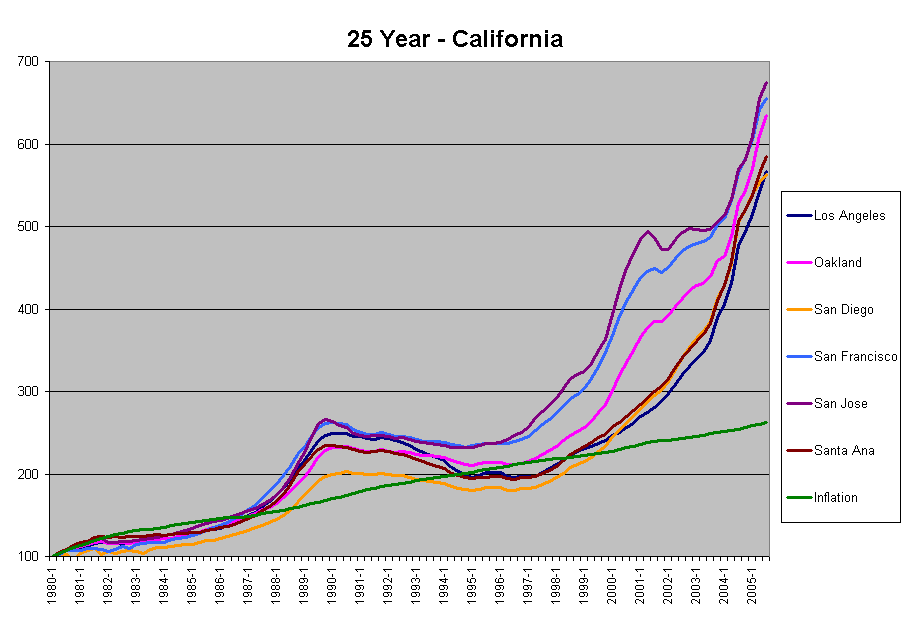
25 Years of Appreciation in California
Check out this graph. I found it here. It shows housing price appreciation over the last 25 years. I ask you, what better picture of the California housing bubble than this? And realtors actually expect us to believe that those curves will level out rising at the rate of inflation into the future. Ha!
Sales Results for December, 2005 for Marin County
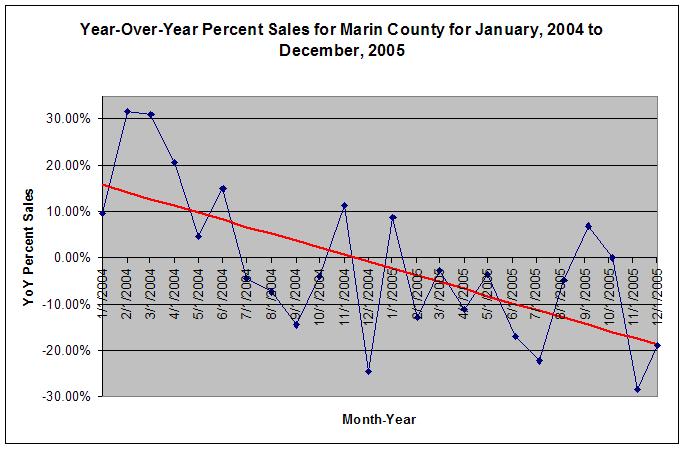
Below are some results of single family house (SFH) sales for December, 2005 in Marin. Percent sales of SFHs are down about -19% as compared to this time last year. The average price is up 11% since November. Condo prices showed a year-over-year loss in price of a little more than 2%.
First, this is what West Bay Real Estate has to say:
What do we make of the fact that percent sales are falling on a year-over-year basis yet the average price is up so much?
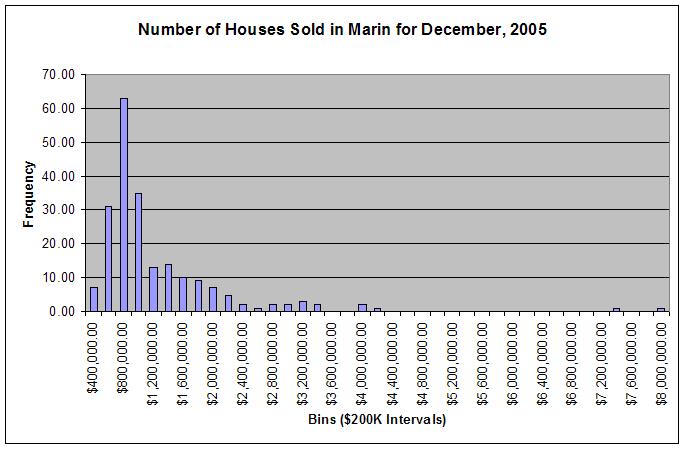
Take a look at the next graph that shows the number of houses sold grouped into sales price bins of $200,000 intervals (so $400,000 on the abscissa means the number of houses that sold in the price range $200,000 to $400,000, $1,000,000 means the number of houses that sold in the price range $800,000 to $1,000,000, etc.):
It's a little hard to see in this graph, but quite a few houses priced in the more extreme price range (say, greater than $4,000,000) sold last month; some for well over $7,000,000. Compare these results with those of October and November of 2005. These extreme values ("outliers" in statistical parlance) significantly affect the average (by shifting the average closer to the outliers) and affect the median by a little. If just the two houses that sold above $7,000,000 in December are removed from the sample (so as to be comparable to the October and November analyses), then the average sales price in December for Marin is $1,073,893 which is down from November's $1,206,201 figure -- in other words a one month loss in SFH sales price of -11%.
First, this is what West Bay Real Estate has to say:
Home sales in Marin County fell 8.3% from the month before, and were off 18.8% compared to December 2004. The median price for single-family homes gained 2.7% to $960,000 from November. The year-over-year appreciation was 9.7%, the third time in the past four months year-over-year appreciation has been in single-digits. The average home price gained 11% to $1,338,698, an annual increase of 24.9%.Here is a plot of percent sales of SFHs over the course of the year. The red line is the best-fitting (least squares) trend line:
The median price for condos fell 6.3% to $506,000, a year-over-year loss of 2.2%. That hasn't happened since December 2002. Sales fell 13.6%, and were off 20.3% compared to last December.
What do we make of the fact that percent sales are falling on a year-over-year basis yet the average price is up so much?
Take a look at the next graph that shows the number of houses sold grouped into sales price bins of $200,000 intervals (so $400,000 on the abscissa means the number of houses that sold in the price range $200,000 to $400,000, $1,000,000 means the number of houses that sold in the price range $800,000 to $1,000,000, etc.):
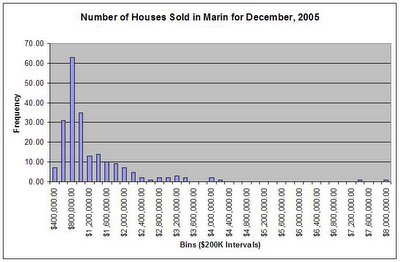
It's a little hard to see in this graph, but quite a few houses priced in the more extreme price range (say, greater than $4,000,000) sold last month; some for well over $7,000,000. Compare these results with those of October and November of 2005. These extreme values ("outliers" in statistical parlance) significantly affect the average (by shifting the average closer to the outliers) and affect the median by a little. If just the two houses that sold above $7,000,000 in December are removed from the sample (so as to be comparable to the October and November analyses), then the average sales price in December for Marin is $1,073,893 which is down from November's $1,206,201 figure -- in other words a one month loss in SFH sales price of -11%.
Sunday, January 15, 2006
Bye-Bye, Bubble?
This article in the The Atlantic Monthly (you need to be a subscriber to read the article) argues that mainstream media reporting on the housing bubble is fading away because it is not popping with the rapidity of the .com bubble. True enough. But the writer is (probably knowingly) committing a grave fallacy: the time scale of a housing market is much different than that of a stock market if for no other reason than it takes a lot of time to sell a house as compared to a stock. Compound that difference in time scales with the fact that it takes numerous transactions spread over time to define a trend and it is easy to understand this difference in the two markets. Although the investor psychology during any speculative mania is the same, in the stock market a bubble pop is measured in days and weeks or months; in real estate it is measured in years. Expecting the housing market to bust over a few days or a few months is ridiculous. So this article makes a straw man argument and then tears it down.Some choice quotes:
Something terrible is happening in the media...The real estate bubble is fading away.But the article ends on a good note [ ;) ]:
Yes, the story of soaring home values that has lit up our lives for the last several years, and produced an incalculable number of breathless headlines and anecdotal leads about Joe and Jane Homeowner; the epic journalistic narrative that lent so much tension and drama to everyday existence (Is there really a bubble? Is it in my ZIP code? Can I make money from it?); the pop-culture phenomenon that launched a zillion identical kitchen renovations with stainless-steel appliances and granite countertops; the boom that filled the Friday lifestyle sections of The Wall Street Journal and The New York Times with display ads for swank "estate properties" that you might actually be able to afford next year if prices on your street keep rising insanely—is dying.
For a bubble story to stay alive, it must either be expanding rapidly, or bursting suddenly and wreaking havoc across the landscape. The tech bubble was a classic of the genre: It grew and grew in the late '90s, sucking in more and more gullible people, and then in a very short time, beginning in March 2000, it just blew, and countless investors lost their shirts. By bursting spectacularly, the tech bubble confirmed itself as a true bubble and became legend.
The media turned real estate into a new kind of socially acceptable pornography.
The problem with the housing bubble is, it's not expanding wildly any more, yet it's not exactly bursting, either. It's being unpredictable and confusing.
This week, I was cruising the real estate blogs (yes, there are scads) when I came across a good one called Marin Real Estate Bubble, "A Place for Residents of Marin County, Calif., and Others to Express Their Views Regarding the Real Estate Bubble." The blog had a new posting about a survey in which 67 percent of Americans said they "believe there really is a real estate bubble," as if it were Santa Claus. And so it was.I'm pleased that a classy journal like the The Atlantic Monthly would mention this humble blog. But I am sorry that they equate this housing bubble with a mythical character.
Friday, January 13, 2006
Monetary Myopia
There's an excellent article in The Economist; I highly recommend reading it. There is so much quotable material that if I did so, this post would be too large; I'll just quote some of the more poignant remarks.On Mr Greenspan's watch, America has also experienced the biggest stockmarket and housing bubbles in history. Presiding over one bubble could be seen as bad luck; presiding over two smacks of carelessness.
The Greenspan era will not end on January 31st. Instead, his legacy will linger in the shape of the biggest economic imbalances in American history: a negative household saving rate and a record current-account deficit (see chart 1). Until these imbalances unwind—a process that could prove painful—it is too soon to applaud Mr Greenspan's record.
The Economist's long-running quarrel with Mr Greenspan is that he chose not to restrain the stockmarket bubble in the late 1990s or to curb today's housing bubble. He has declared himself vindicated in not pricking the equity bubble with higher interest rates, but instead to let it burst and then cut rates sharply to “mop up” the damage.
Asset-price inflation can be as harmful as conventional inflation. A sudden collapse in share or house prices can trigger a deep downturn.
From a risk-management perspective, the case for acting against the housing bubble is even greater than for the stockmarket bubble. A housing bubble has bigger wealth effects on consumer spending, so a collapse in house prices would cause more economic harm than one in share prices. Such a bubble is more likely to create financial instability because people borrow more to buy homes. And raising interest rates is a more powerful tool against rising house prices than share prices.
In December Mr Greenspan was made a Freeman of the City of London. One of the traditional perks of this honour is that he can be drunk and disorderly without fear of arrest. The snag is that his policies have also encouraged drunk and disorderly asset markets and intoxicated consumers. When the party ends, Mr Greenspan will not be there to clean up the mess. But end it surely will.
Thursday, January 12, 2006
Marin Market Ratings
Below is a graphical representation of market ratings (e.g., "Strong Sellers", "Balanced", "Extreme Buyers", etc.) for Marin County for the period spanning October, 2004 to January, 2006. I found the data here. To make this bar chart, I arbitrarily assigned an ordinal to each rating as follows:
So, the shorter the bars in the following graph, the more of a buyers market it is; the higher the bars, the more of a sellers market it is.
This time last year Marin was a "Strong Sellers Market". Today Marin is a "Strong Buyers Market".
It is worth taking a closer look at her data. Basically, the "cheapest" houses are in the "Sellers Market" or "Balanced Market" range; anything priced at a million dollars or more is in one of the "Buyers Market" categories. As interest rates rise and/or "exotic" loans become harder to obtain I should think we would see the low end price range convert to one of the "Buyers" categories. But as it stands now, if you want to be in one of the "Sellers Market" categories then you have to lower your price.
And you gotta love the spin this realtor tries to put on her data.
1 = Extreme Buyers Market
2 = Strong Buyers Market
3 = Buyers Market
4 = Balanced Market
5 = Sellers Market
6 = Strong Sellers Market
7 = Extreme Sellers Market
This time last year Marin was a "Strong Sellers Market". Today Marin is a "Strong Buyers Market".It is worth taking a closer look at her data. Basically, the "cheapest" houses are in the "Sellers Market" or "Balanced Market" range; anything priced at a million dollars or more is in one of the "Buyers Market" categories. As interest rates rise and/or "exotic" loans become harder to obtain I should think we would see the low end price range convert to one of the "Buyers" categories. But as it stands now, if you want to be in one of the "Sellers Market" categories then you have to lower your price.
And you gotta love the spin this realtor tries to put on her data.
Tuesday, January 10, 2006
"Liar, Liar Pants on Fire" Loans
Here is an article about mortgage fraud vis-à-vis stated income loans. It seems it is ok to commit mortgage fraud as long as everyone is making money. I wonder how prevalent stated income loans are in Marin. Any Marin mortgage brokers lurking on this blog who are willing to post their thoughts on this topic (anonymously, of course)? In any event, it will be interesting to see what comes to the surface after the you-know-what hits the fan.Some choice quotes:
While the big scams grab headlines, industry insiders caution that the bulk of the fraud infesting the real estate industry could well be a lot more subtle.
Stated-income mortgages do not require a borrower to provide proof of their income to a lender. Instead, a borrower "states" how much they earn on their application. Some local brokers said these loans seem almost designed with fraud in mind. They now refer to these loans as "liar's loans," because, they said, the freedom plays into the hands of unscrupulous mortgage brokers and borrowers.
Brokers and other industry insiders admitted such loans have made fraudulent income inflations a very common occurrence in the mortgage industry.
Sam Jarman, manager of Charter Mortgage in San Diego, made a conservative estimate that 25 percent of stated-income loans are fraudulent. However, he said such a figure was impossible to verify, because nobody seems to know how widespread the problem of inflated-income mortgage fraud has become.
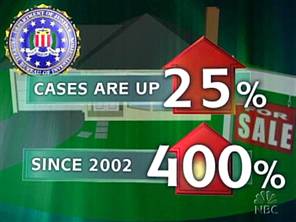
Certainly, the FBI thinks such fraud is a problem.
Swecker attributed this fraud to inadequate oversight of the industry, particularly mortgage brokers.
A Housing Bear
I'm sorry about not being able to post much lately.I found this article which does a nice job of factually summarizing the housing bear point of view for those of you who are so inclined to entertain it. Most of the points made in the article apply more or less equally to Marin since despite Marin's inward-looking nature, and dare I say "narcissism", we are nevertheless a part of the rest of the economic world. At the very least it should generate a lively discussion.
Some other points to consider: The author makes a case for why the Fed will continue with rate hikes but failed to mention that not doing so also risks further weakening the dollar. Also, while reading the article this graph would probably be better to refer to instead of the one the author uses which is for San Diego. Further, it is worth keeping in mind that the difference in rates between ARMs and longer-term loans is narrowing (as can be seen here) and I don't think moving to 40-, 50-, or 60-year loans will do much good for the reasons explained here.
Subscribe to:
Posts (Atom)