Saturday, December 10, 2005

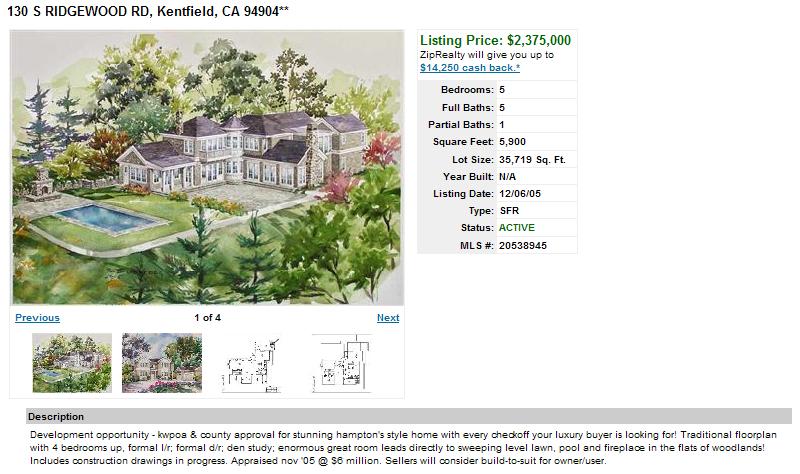
40% Drop in Price for High End Marin House

Just a quick post:

Here is a listing for a high-end house in Kentfield (rather, a house that will be built) whose price has dropped 40% in one month if you can believe the realtor's November, 2005 appraisal claim that is (makes one think twice about the possibility of appraisal fraud in Marin County). I've already entered it into the Marin Address Pricing History thread for future reference.

(Click on the image for a larger view)

GDP and the "Healthy" Economy

Some people (especially realtors) like to argue that the worst case scenario now for the housing market is a so-called "soft landing" or stagnant pricing power. The support for their argument is usually along the lines that the economy is healthy. Personally, I don't know what planet they are talking about because here in my corner of Earth I don't see many signs that the economy is particularly healthy; I see a lot of people who either work for significantly less money than they did a few short years ago or who in some way or another are dependent on a continually expanding housing bubble. Maybe it depends on what one means by "healthy".

Well, over at CalculatedRisk there is a nice graph and article that illustrates what "healthy" means; the graph is reproduced here, below. In the graph, "MEW" stands for "Mortgage Equity Withdrawl".

Friday, December 09, 2005

Hard Landing Now Seems Likely on East Coast

According to this article, price cuts of 20% are now commonplace in the East Coast housing market and analysts are saying that a "hard landing" (i.e., a crash) is far more likely. And foreclosures are up 35% It seems that they are entering a downward price spiral that will be difficult to reverse. Just a month or two ago it was all "oh, prices will soften and appreciation will only be the normal 5% or so...it will be a 'soft landing'". Is the East Coast a harbinger for the West Coast? How are their amygdalas doing I wonder?

Some choice quotes:
"Boston-area homeowners trying to sell their houses are sharply reducing asking prices -- in some cases, by $100,000 or more -- in response to the sudden slowdown in the real estate market."

"Demand for single-family homes has declined as prices have risen in recent years and interest rates have begun to climb, causing the number of properties on the market to pile up."

"...reductions in asking prices of 10 percent or 20 percent are now common in both high and moderately priced neighborhoods..."

"''The evidence -- both early data and the anecdotes -- are pointing more toward a hard rather than a soft landing" in the housing market, said Nicholas Perna, an economic consultant in Ridgefield, Conn. ''Prices could come down. Could it be 10 to 15 percent? There's no way of knowing, but what we're getting is more clues that you've got a decline in prices underway."

"Some houses are now listed below what buyers paid a few months ago for a similar house, making it very difficult for real estate agents to estimate an asking price for clients."

Get Ready for a Storm of Law Suits?

This article made me shake my head and sigh. There are a ton of people out there "buying" houses using only IO or NegAm (or other "exotic") loans because it is the only way that they can afford to buy. Then they find out that their monthly payments skyrocketed after a year or so and now they can no longer afford their mortgage. So like any good American citizen these days, they call a lawyer and sue the lender.

I'm sorry, but if the only way you can "afford" to "buy" a house is by using one of these "exotic" loans, then you really couldn't afford to buy it in the first place. Ignorance of the terms of the loan is no excuse as it is your responsibility to read the loan agreement. Am I wrong? If so, let me know and put me in my place.

And rumor has it that here in Marin something like 80% of all loans are of the "exotic" type and probably more than half of those are not to the über-wealthy who just want the tax benefits. As people's monthly mortgage rates begin to change over, get ready for a lot more of these sorts of stories in the news.

Some choice quotes:
"One reader wants to know what to do if his mortgage payments skyrocket next year. That's because he has an adjustable rate mortgage with negative amortization -- the monthly payments aren't enough to cover the monthly interest owed, the result being that the additional interest gets tacked on to the principal due."

"Under such a scenario, even if mortgage rates don't change, his monthly payments likely will rise. Many adjustable-rate loans with such a negative-amortization option -- meant to help borrowers qualify for the loans -- eventually adjust the payments to recapture the lost interest."

""This is the only way I could afford to buy a house...""

"A lot of people are in the same boat. They've signed onto an interest-only payment mortgage or a mortgage with negative amortization because it was the only way they could qualify for a home loan."

"To be sure, initially, monthly payments with these mortgages are significantly lower than monthly rent. But unless the home price appreciates greatly and the buyer is thinking about selling fast, such loans rarely make a lot of sense."

Surreal Estate

A reader brought my attention to this article in the SF Chronicle. Here is an otherwise unremarkable person who has no job, no steady income, and yet who chose to go $2.3 million into mortgage debt, with an average negative cash flow of $10,000 per month. On paper she and her partner are very wealthy. In truth, they are dependent on debt extraction. This degree of leverage reminds me of the Long Term Capitol Management business model and we all know (or should know) how that ended (and those guys were all Ph.D.s for crying out loud!). But the thing is, this is not an isolated case; it is going on all around us. It is vigorously encouraged by the RE industry, lenders, the Fed (remember Greenspan touting the goodness of ARMs at one time?), "the Jones", and others. Here in Marin real estate investing is of epidemic proportions as it is something of a hobby and really has become our only industry.

So what happens when the RE cycle changes as it seems to be doing now and as it has always done in the past? Should lenders be allowed to lend to people in this position? If their house of cards blows away, who should be held accountable? The borrower? The lender? Someone else? For my part, I don't begrudge anyone financial success in the real estate market; but irresponsible lending (and that is what I think is at the heart of it) needs to be significantly reigned in. And the only way to effectively reign it in is to make the lenders personally liable for the consequences of poor lending decisions -- use people's self-interest for positive social change.

What can YOU do? Share your thoughts.

Some choice quotes:
"In the three years since Sacco and McCook put their faith in real estate, the couple have embarked on what might conservatively be called an E-ticket ride, pulling equity from appreciating properties to provide down payments for the next investment. They have bought eight vacation properties - four homes in Florida, three in California and 100 raw acres on top of a mountain in Lake County."

"They don't have jobs, but their lives appear to be a whirlwind of work. They don't have incomes either, though they maintain middle-class lifestyles."

"Sacco estimates that along with McCook's mother, who has been a silent partner, they've made $1.3 million since they began their buying spree, but all of this is still in equity on their properties. Their monthly reality is more sobering. They have $2.3 million in mortgage debt and negative cash flow that ranges from $5,000 to $15,000 monthly depending on the season."

"So how do they pay the bills?"

""We sort of count our equity loans as our income," she says, with the slightest wince. "If we had real jobs, we'd be fine, but we just need to get some money in. Some people call it a pyramid, but I don't like to think about it that way.""

"Surreal financing? Bubble economics? Perhaps. But it's also the way people are increasingly approaching real estate: as a bet..."

"Whether it's first-time buyers who take out interest-only loans or investors who extract equity from one property to fund the next, real estate is an industry that is being buoyed by a belief in continued appreciation."

Thursday, December 08, 2005

Short-Sighted New Era Speculation

This article from Sonoma got me thinking. Part of the answer to why this housing bubble has formed must reside in the increasingly short-term thinking of buyers and sellers. Vast numbers of people are taking out these hugely risky adjustable rate mortgages, with or without money down, in an environment where interest rates can only go up in the foreseeable future. Why do they do it? It does not seem prudent. Some claim it is because they only want to live in the purchased house for three or four years. Yet at the same time they speak of raising a family which, I can say from personal experience, requires more than three or four years. Have people always been so short-sighted or has the sheer unaffordability of California's houses (and those elsewhere) these days forced short-term thinking on people? To me, no matter how you look at it, anyone who buys a house with these terms is speculating, whether they intend it or not.

What is the cost to our society? To our community? And what happens to these people when prices come down? It seems arrogant to presume that the lessons of the past do not apply to the present, but if you think prices won't come down, then be prepared to explain why historical patterns no longer apply? Is it because "it is different this time" aka it's a "New Era," a "Brave New World"? Let's review some New Eras of the past. There was the "New Era" of the 1920s (technological innovations -- automobiles, electrification, vacuum machines, washing machines, radio, etc.); that ended badly and has been forever burned into our collective consciousness as The Great Depression. Then there was the "New Era" of the mid-1950s (victory in the Pacific and Europe was still a fresh memory, increasing peace as post-WWII tensions subsided, more technological innovation (e.g., television), the baby boom and the resultant spending, increased consumer credit, the announcement in 1961 of the intended moon landings); that ended badly too with the 1972 stock market crash. Then of course there was the "New Era" of the 1990s which we are still living through in some ways (development of the PC, the Internet, the breakup of the Soviet Union, the high-tech industry, cell phones, Alan Greenspan and his cheap money); we all should know how that one both ended (NASDAQ crash) and lives on (housing boom).

Well, that was some tangent.

Some choice quotes:
"During the mid- to late-'90s, home buyers in Sonoma County could sign their escrow papers with the smug feeling that at least they weren't paying Marin County prices. But with the median home price in Sonoma County having reached $616,000 as of September, that smug bubble has burst, though the housing bubble has not."

"Since, according to the Bay Area census, the median income of Sonoma County households ranges from $50,000 to $63,000, where are people coming up with the money to buy these $616,000 homes? They're not, exact-ly."

""Sixty-five to 70 percent of all the loans I do are interest-only options," says Daniel Barwick of Benchmark Lending in Santa Rosa."

"With interest-only loans, money paid monthly toward a mortgage does not reduce the principle owed, but it's a gamble that many new homeowners seem willing to take."

"According to Barwick, many homeowners opt for these loans because they intend to sell their homes in three to four years and are banking on their property value to increase exponentially; often, it is the only way they can afford a mortgage."

""Most people want the lowest payment possible, because they know their equity will grow," Barwick says. "I have some clients who actually live off the equity in their home. They refinance every three years and take out two to three hundred thousand and live on it.""

"But let's look at who gets priced out of the housing market: the teachers, policemen and other civic and civil employees who live here."

""People are being forced to buy houses way outside of their means because there are few alternatives," he says. "Who wants to be in debt for 30 years or spend a lifetime making house payments?""

""I was born in Marin and think of Sonoma County as my home. I can't imagine being an expatriate year-round. It seems somewhat unreal that I can't [afford to] stay here, but as a poet, and really an artist my entire life, I can't imagine paying a $2,000 to $3,000 mortgage during my last 20 years of great energy and creativity. This gives me great sadness. I was a naturalist for Pt. Reyes years ago and so much of my writing comes from the land here, is integrated here and born of it.""

"She shakes her head. "Never being able to settle here is devastating.""
And be sure to read on and check out the "creative" lengths people will go to feel like they "own" a house: helping to actually build it, shared housing (communing), land share (co-ownership), apartment condo conversions, really tiny "homes" (70 to 750 sq ft).
Concerning the Marin Real Estate Industry

I have received a tremendous volume of email from readers of this blog. Thank you for all your kind words. I am so relieved that this blog provides some service to our community. Our COMMUNITY!

Quite a few of the emails I received were from Marin realtors or ex-Marin realtors who have said some rather surprising things (some being "jaw-dropping" and "eye-popping") about that industry. Instead of quoting excerpts from those emails and given the recent increase in reader participation, I am opening up this post to anyone who has anything they want to say about the Marin real estate industry. "Insiders" are strongly encouraged to participate.

Topics of interest include, but are not limited to, industry practices, realtor personalities, realtor qualifications, the sorts of loans the typical Marin buyers take out these days vs. days past, the typical motivation of Marin buyers (e.g., the frequency of those buying to live in a home, raise a family, etc. vs. buying to invest), etc. I leave it up to you the direction taken in this thread. I hope you will participate as I know there is a lot of interesting information in your collective heads. Basically, I am looking for any information that will shed light on Marin's real estate market vis-à-vis the industry itself.

This topic is something of an "experiment" for me as a new blogger.

Rule 1: Play fair, play nice, be truthful.

Rule 2: Do not refer to anyone or any organization by name or by any means of identification. Doing so will get your post deleted.