Wednesday, May 31, 2006

"A Sad Distortion of Social Priorities"

Well, I guess I am not alone afterall in claiming that strict environmental zoning and artificial land-use restrictions are counter-productive and socially disruptive. Further, despite our claims that we are oh-so-progressive, this article claims that such land-use restrictions are in fact anti-progressive.

Land-use restrictions were started, or so it is claimed by their proponents, in order to make the Bay Area more "livable" (insert your favorite intangibles here). To no one's surprise the artificially created scarcity of land has made housing unaffordable in the Bay Area and has no doubt inflated our egos to match ("Wow! I live in a million dollar 2 br 1 ba hill shack. We must live in the best place ever!"). This pathetic situation has only been exacerbated by the run-up due to the incredibly easy access to credit, exotic "toxic" loans, etc. all of which add up to the housing bubble mess that we are currently living in. But like this article says, "how livable is a place if you can't afford to live there?"

It was well known in the 70's (as attested to by my boomer parents and their friends who still live here) that these restrictions would primarily preserve if not increase land values and that was a big part of it. Property values clearly took precedence over building a healthy community, kids' education and development, social mobility, diversity, business, etc.

That was the choice made by the previous generation. But we don't have to sit idly by.

Marin County's (and others') land-use restriction policies are best summed up by the article as "a sad distortion of social priorities". As much as I like pasture land and trees, I couldn't agree more. It is at best an experiment that has gone awry. Flame away if you must, but someone has to ask the hard questions in public and it might as well be me and besides, what better medium than a blog?

The sooner that we acknowledge that a problem exists the sooner we can address it. I don't think more of the same can be tolerated. I'm afraid that if things do continue on as they have been then there may be no businesses left or the only way to make sufficient money to live here will be more frequent and more extreme boom-bust cycles, more get-rich-quick schemes (e.g., options), more who-knows-what.

Some choice quotes (emphases mine):
Most people know that the San Francisco Bay Area has one of the most expensive housing markets in the nation. However, not everyone realizes that, as recently as 1970, Bay Area housing was as affordable as housing in many other parts of the country.

Data from the 1970 census shows that a median-income Bay Area family could dedicate a quarter of their income to housing and pay off their mortgage on a median-priced home in just 13 years. By 1980, a family had to spend 40 percent of their income to pay off a home mortgage in 30 years; today, it requires 50 percent.

What happened in the 1970s to make Bay Area housing so unaffordable? In a nutshell: land-use planning. During the 1970s, Bay Area cities and counties imposed a variety of land-use restrictions intended to make the region more livable.

These restrictions included urban-growth boundaries, purchases of regional parks and open spaces and various limits on building permits. These regulations created artificial land shortages that drove housing prices to extreme levels. Today, residents of Houston, Texas, can buy a brand-new four-bedroom, two-and-one-half bath home on a quarter-acre lot for less than $160,000. That same house would cost you more than five times as much in Marin or Contra Costa counties, seven times as much in Alameda County, and eight to nine times as much in Santa Clara, San Mateo, or San Francisco counties.

In fact, planning-induced housing shortages added $30 billion to the cost of homes that Bay Area homebuyers purchased in 2005. This dwarfs any benefits from land-use restrictions; after all, how livable is a place if you can't afford to live there?

The benefits of protecting open space are particularly questionable. The 2000 census found that nearly 95 percent of Californians live in cities and towns that occupy just 5 percent of its land. Many San Francisco Bay Area counties have permanently protected more acres as open space than they have made available for urban development. When such actions make it impossible for middle-class families, much less low-income families, to afford their own homes, they represent a sad distortion of social priorities.

Moreover, as in the 1980s, California's fast-rising home prices have attracted speculators who have created huge bubbles in the state's housing markets. Bay Area prices fell by 10 percent in the early 1980s, 20 percent in the early 1990s, and are likely to fall even more as the bubble deflates in the next few years.

The impacts of high housing prices are also reverberating throughout the region's economy. First, economic growth has slowed as businesses look elsewhere to locate offices and factories. High housing costs have also increased prices for food and other consumer goods; retailers now pay $1 million per acre or more for store locations. Far from reducing driving as planners desire, high housing prices force many commuters to live farther away from their jobs, forcing more cars onto the roads. Ironically, an obsessive focus on protecting Bay Area "farmlands" (in fact, mostly marginal pasturelands) forces people to move inland and more rapidly develop the highly productive croplands in California's not-yet-so-unaffordable Central Valley.

The people most enthused about all these planning rules like to call themselves ''progressive.'' But the effects of planning on home prices are entirely regressive. Planning-induced housing shortages place enormous burdens on low-income families but create windfall profits for wealthy homeowners. Does this steal-from-the-poor, give-to-the-rich policy reflect the Bay Area's true attitudes?

Homeownership is more than just a dream, it is a vital part of America's economic mobility. Most small businesses get their original financing from a loan secured by the business owner's home. Children in low-income families who own their own homes do better on educational tests than those who live in rental housing. Barriers to home ownership reduce this mobility and help keep low-income people poor.

Predictably, planners' solutions to the housing affordability problem often make the problem worse. Planners typically require that homebuilders sell or rent 15 percent of their homes at below-market rates to low-income families. The homebuilders simply pass that cost on to the buyers of the other 85 percent of the homes they sell. Existing homeowners, seeing that new homes suddenly cost more, raise the price of their homes when they sell. The result: A few people benefit and everyone else pays more.

The solution to the Bay Area's housing affordability crisis is not a few units of affordable housing, but widespread land-use deregulation that will make housing more affordable for everyone.


Tuesday, May 30, 2006

Housing Bubble Bloggers Under Attack?

I received this email today, quoted below.

Despite all of the insults that we bubble bloggers are just stupid and wrong, don't get it, just bitter renters, jealous, doom-and-gloomers, etc. ad nauseam..., if we were just your typical It's-The-End-Of-The-World freaks talking to themselves like you can find on most any corner of downtown, then no one would bother attacking us or paying any attention to us.

Instead, because we bloggers have loosened their (the Real Estate "Cartel", the Real Estate "Complex") precious grip on information, they have to resort to unethical tactics which are all too familiar to them. Do you remember how "an army of cyber geeks" tried to find out my identity during that exchange with the Marin IJ? Same deal IMO.

Boycott housing.
I've been made aware that three housing bubble blogs, hosted
on blogger (blogspot) have been attacked and taken down today:

http://overvalued.blogspot.com
http://thereisnohousingbubble.blogspot.com
http://crash2006.blogspot.com

These sites are now redirected to spam sites. There may be others, and the attack may be ongoing.

I've changed my password on blogger, am logged in to avoid a logout, and backed up my code, however, the real risk may be the archives. I'd hate to lose those.

Yes, we are going up against some big forces and big $$$ - the NAR, millions of soon to be unemployed realtors, the entire corrupt Real Estate Industrial Complex. I'm surprised it's taken this long to attack us."

Sunday, May 28, 2006

Marin Contractor of 35 Years Shares His Thoughts

I was contacted by a reader who mentioned that her father, a Marin resident and a contractor here for 35 years, is bearish on Marin real estate for at least the next couple of years due to the local housing bubble. Here's what she told me (reprinted with her permission):
Also, FYI, my dad, who is a contractor in Marin... told me today that he sees prices dropping 10-15% at least. He remembers the last housing bust here, and thinks it could actually happen again. He recommended that I sock my down payment away and wait it out for 2-3 more years, even with interest rates rising.
I asked if her father would be willing to share his thoughts in more detail on this blog and he agreed.

Here is the context of his response:
We were talking about the state of the market in Marin. I asked him for his comments on the current state of the market and whether it was a good time to buy or not. He answered in terms of the next 2 years.
And here is his response:
Look at the sum of the information:
  • Recent significant property value/price run ups
  • Increasing interest rates
  • Increasing commodity prices
  • Huge tax/budget deficits which must drive up interest rates and taxes even more. Higher rates will be needed to attrack buyers for our bonds which will drive the other rates. Fed is holding on to limit rate changes for political reasons.
  • Bank of Japan and other overseas money supplies are tightening.
  • Stock market is skittish and looking to go bear. Money moving to commodities and to overseas markets. Even good companies with good prospects will have a harder time attracting capital and maintaining stock value.
  • Individuals income is increasing in only a very small segment of the scale. The top 1-2%. Most everyone elses income is stagnant.
  • Recent upward shifts in number of properties listed with fewer sales and a greater number of reduced prices being considered by the sellers.
  • A large percentage of real estate purchases have/are being closed with extreme conditions: i.e. no money down, short term variable rate notes to squeeze in the deal leaving ittle or no equity at closing. Leaving many owners with with little incentive to avoid default and foreclosure when rates in the note increase o refinancing is required and no appreciation has occurred.
All this squeezes cash flow available for payments and hurts peoples confidence in their ability to make these payments. Long term loans are extremely sensitive to interest rate changes. i.e if you have $3,500.00/mo for a mortgage:
  • The most mortage you can carry is 600K at 5.5% or 550K at 6.5% or 500K at 7.5%
As a buyer at 7.5% your best offer will be 500K not 600K. Ability to pay a mortgate drives prices in the lower to mid range areas of the markets.

I think fewer lenders can continue to offer the variable loans given the lack of short term property appreciation expectation. The lack of expected appreciation will tighten the mortgage resale market for the notes that come out of these loans. Too much risk.

You have noticed the trends. This is systemic with little chance of a momentum shift away from this any time soon. Keep your eyes open. At some point the momentum will ease and it will be time to act.

In addition I see them in what I do. As an estimator/contract administrator for a residential construction co. working in the 1.2 m to 3.5 m range. I am noticing:
  • it is much more difficult to fit a budget and tons of increasingly costly products and commodities into a deal.
  • construction loan LTV's are tightening with lower appraisals requiring more capital up front for the lenders to give the OK. Clients are telling me the construction loan roll overs deals with permanent financing included are getting more difficult to complete.
  • clients can get less for their money that they expected and are not moving ahead with these construction projects. Even those with cash are being more careful.
  • greater client concern over property values vs. the cost of property and construction. Every recent tear down and new custom home deal I have seen costs out more than the reasonable property value at the end of construction. This has disuaded many clients and makes it very difficult to negotiate and maintain profit margins.
It's nice to occasionally have an insider's point of view or at least that of someone who makes it his profession to be knowledgeable about the Marin market.

Saturday, May 27, 2006

The California Economy -- Housing Boom or Bubble?

This video says it all. Expect to spend 50 minutes. It's well worth the investment in time IMO.

[For better viewing quality, consider downloading the video and the Goggle Video software both of which are available at that site.]

Tuesday, May 23, 2006

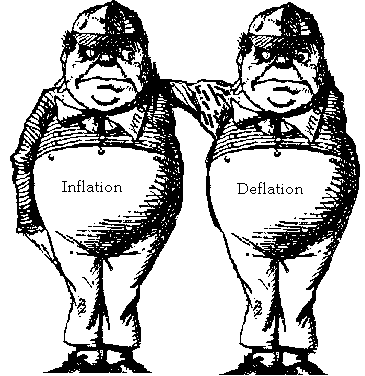
Inflation or Deflation?

So which is it going to be, inflation or deflation? Scylla or Charybdis? Tweedle-Dee or Tweedle-Dum? I dunno. People profiting from the housing bubble are certainly hoping for inflation. This respected blogger argues for deflation. If so, cash will be king and your outrageous mortgage debt will be crushing. So place your bets.

Fannie Lereah

Yep, that's what he (David Lereah, chief economist for the National Association of Realtors) said. Check it out over at the Bubble Meter blog, or the Sonoma Housing Bubble blog, or the Housing Panic blog,...

And be sure not to miss the blistering report (overview here; warning: both are PDFs; kudos to the Bubble Meter blog for these links) by the Office of Federal Housing Enterprise on Fannie Mae where it is said:
...an arrogant and unethical corporate culture where Fannie Mae employees manipulated accounting and earnings to trigger bonuses for senior executives from 1998 to 2004...

...a company whose prestigious image was phony...

The image of Fannie Mae as one of the lowest-risk and 'best in class' ’ institutions was a facade...

...an environment where the ends justified the means. Senior management manipulated accounting; reaped maximum, undeserved bonuses; and prevented the rest of the world from knowing...
Welcome to what may be the largest scandal in our life time; Enron's got nothing on Fannie Mae.

Monday, May 22, 2006

Wall Street Says 'Duh'

Well, it seems Wall Street finally 'gets it'. It's fun-duh-mental they say. There is a housing bubble, it was caused by irresponsibly lax lending practices (I won't even use the word "standards"), and it can only end badly.

What happens to the housing market when no one can squeeze into a mortgage at these ridiculously high house prices when they can no longer get a no money down, no doc, adjustable rate aka "toxic" loan (which comprised about 80% of the loans issued in the Bay Area last year)? What happens when house appreciation falls below the rate of inflation and people can no longer use their houses like an ATM? What happens as all those ARMs reset? What happens as foreclosures continue to rise?

Unless the entire US financial system is at risk of collapse, there sure as hell better not be a bailout of the lenders or the borrowers IMO. There is no way that I want my tax dollars bailing out those damn fools who took out these insane loans and are now finding out that they could not really afford their overpriced POS afterall and that, surprise, surprise, they are actually responsible for their debt. And why should we bail out the idiots who made those loans in the first place to people who they knew full well were not suitable for them?

I hate Mondays.

Some choice quotes:
Lo and behold, housing is a concern on Wall Street. Even the stock market’s cheerleaders have had to acquiesce. The fact is, any economist worth his salt has been concerned for 15 months. That’s how long new-home inventories have been hitting record highs.

Maybe what we should be asking is how inventories, of both new and existing homes, grew to their current records. The answer gets to the root cause of the housing bubble, the credit binge.

Consider that only one of the 53 banks surveyed by the Federal Reserve through the three months ended in April said it had tightened lending standards. About 10 percent had the gumption to loosen standards further. With no lending standards to speak of, it’s been almost impossible to corral the speculation that drove sales and home prices to their bubbly heights.

At issue are nontraditional mortgages that carry adjustable rates or allow the balances to grow with time. (Hint to lenders: Loans are actually supposed to be paid down.) The fact that such nontraditional terms now account for one in five mortgages outstanding suggests someone’s let the fox into the chicken house.