Thursday, October 26, 2006

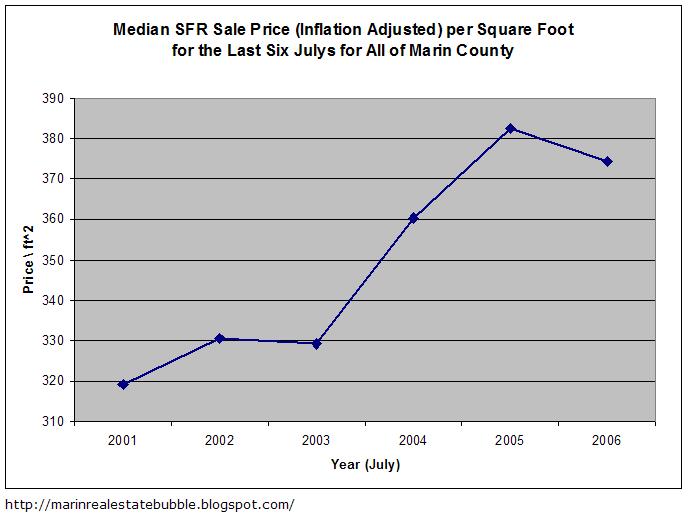
Marin Price per Square Foot for Each July from 2001 to 2006

When people start leaving scary movie recommendations in the comment sections of my posts, then I know I have been neglecting this blog for too long. My new job is taking my full attention. When things settle down more I'll resume updating this blog in a more timely manner.

But until then... below is a chart of the median Marin County SFR sale price per square foot, adjusted for inflation, for each July since 2001 to the present. This is a year-over-year comparison so "seasonal variations" are accounted for. I chose July for no particular reason other than it is usually an active month for housing. Adjusting for inflation allows for a more valid comparison of each year's price/sq. ft. dollar value. I found the inflation data here and the median sales prices and square foot data came from the Marin Assessor's Office (their data only goes up to August, 2006 by the way).

Enjoy.

Tuesday, October 24, 2006

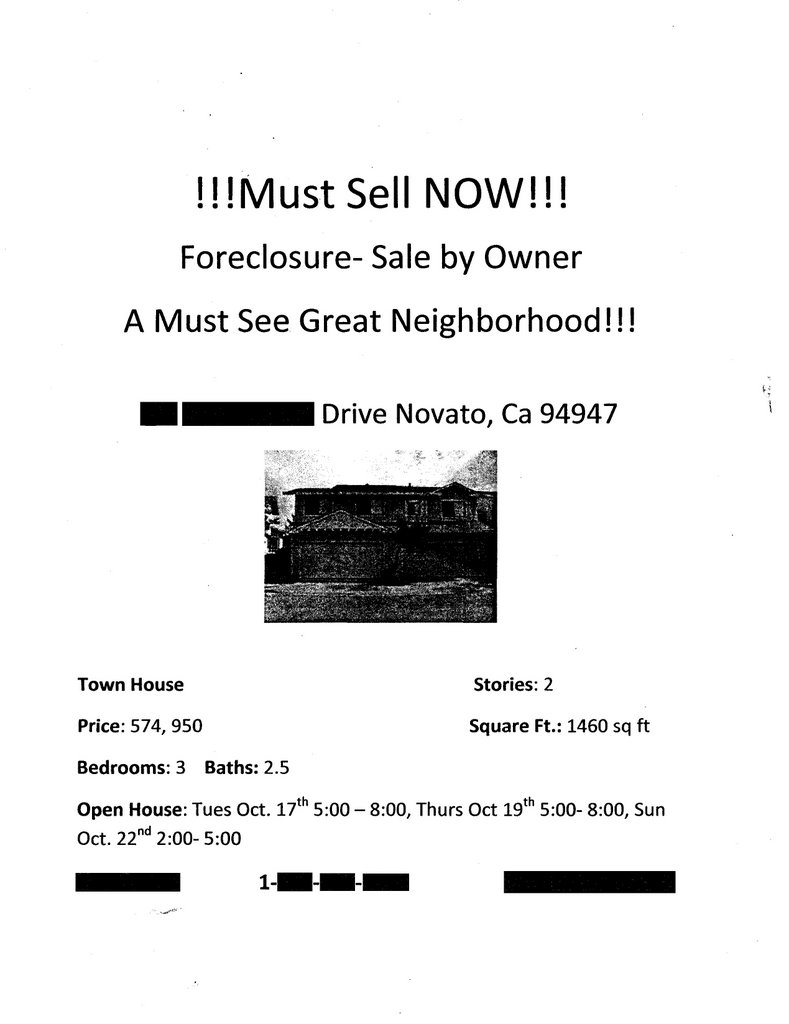
Desperate Times?

Update 10-26-2006: This looks like a legitimate foreclosure. One of many to come. A reader did some checking on this property for me and here is an excerpt from his email:
Here's what I found. Deliquent on their property tax too. Wonder what the lien was for. This should be a recurring pattern. With $511k as the middle of the road ( roughly ). She owes $480+150=$630k. This will probably show up as an REO...unless someone shorts it at the bank. Which is maybe why she's asking $575 ( the second usually does to limit loss).
This was left for me under my car's windshield wiper the other day while I was out doing some errands:

Sunday, October 22, 2006

Schadenfreude - It's the Word du Jour or What's For Dinner

With the dramatic decreases in the year-over-year percentage number of sales, all time lows in market activity, realtors (like Lereah) essentially begging sellers to lower prices so as to get transactions moving again, a proliferation of 'for sale' signs in this normally slow part of the season, one must wonder if we are starting to see a classic "seizing up" in real estate markets:
Unlike stock market bubbles, real estate bubbles don't pop. Collapsing stock market bubbles are characterized by a sudden collapse in prices because stock markets are highly liquid. You see huge volumes of transactions at ever lower prices during a stock market collapse. Collapsing housing bubbles, on the other hand, are characterized by illiquidity, a sudden collapse in transactions. Buyers and sellers seem to disappear. The reason is a reversal in the psychology of buyers that developed at the top of a speculative housing market. Buyers had been buying at prices they knew were too high but on the assumption that they'd be able to sell if they needed to. The thought was: "Ok, maybe it's overpriced, but at least I'll be able to sell it later for at least what I paid for it, but likely more." What happens on the way down is that houses go on the market and just about NO ONE shows up to look. That's because buyers weren't buying earlier primarily because they needed a place to live, but because they thought the price would likely rise and that, in any case, they'd be able to get out when they wanted with all of their money or more. On the way down, neither condition is true. So buyers stay home, so to speak.

But can't buyers be enticed by declining prices, by bargain hunting, you ask? No. Once housing sale transactions suddenly fall from, say, several hundred a month in a large community to, say, one or two a month, this creates fear and loathing about prices. Long periods of time pass when there are no transactions at all. Think of it this way. What's the comparable on your 3000 square foot home in San Mateo when the last sale was, say, seven months ago? Is it 10% less than the last sale of a similar home on the area? 30% less? This happened in Japan, and prices nationally are still more than 60% below peak prices in 1992, where real estate prices continued to climb for several years after their stock market bubble popped. Sound familiar?
Q: What happens when you can no longer reduce your asking price without going "under water"?

A: You just decide to sit on it for an unknowable length of time and hope for a better market in the future all the while hoping that during the meantime you won't be forced to sell due to illness, job relocation, divorce, a huge law suit, a disabling accident, kiddies go to college or some other large expense, etc.

And this never ceases to be fresh:
Justifications for abnormal price increases are themselves a symptom of an asset bubble. Ones I’ve been hearing to justify housing prices in recent years are similar to those I heard here at iTulip.com in the late 1990s about the stock market. The more a person had invested in the stock market, the more strongly he pushed the justifications for absurd prices, and the closer we came to the end the more rabid the defense.

There are nine key plausible but wrong "it's different this time" arguments most commonly used to justify housing prices during the bubble:
  1. low inventories;
  2. modest mortgage rates that will not rise high enough or fast enough to end the price expansion,
  3. favorable long term demographics of boomers and retirees,
  4. growing demand from immigrants,
  5. the Internet has eased the cost and time needed to buy or sell properties,
  6. banks and mortgage companies have automated mortgage underwriting, making financing a shorter and simpler process,
  7. financial innovations have created new mortgage products to make homes more affordable to more buyers,
  8. low-income assistance programs will continue to boost the level of U.S. home ownership, and
  9. the 2000 stock market downturn and 9/11 attacks motivateed investors to avoid the risky stock market and put their money “safely” into real estate.
Taking on the nine key justifications one at a time:
  1. inventories are rising just about everywhere and rapidly in some areas such as Denver, Colorado;
  2. interest rates are now rising fast making not only monthly payments too expensive for homeowners with barely affordable ARMs but also making a switch to a fixed rate mortgage unaffordable for many;
  3. baby boomers and retirees made up 40% of all home purchases in 2005 so they’re probably full up;
  4. immigrants can only afford homes if monthly payments are kept inexpensive via low interest rates and Suicide Loans, but these are going away;
  5. the Internet will be just as efficient as a mechanism for transmitting price deflation in a declining housing market as it was at transmitting price inflation when the market was rising;
  6. banks are tightening lending standards as foreclosure rates rise, making loans less available;
  7. Suicide Loans are behind the first wave of foreclosures in places like Denver, so banks and mortgage companies are taking them off the market and there is proposed legislation by banking regulators to place severe restrictions on them,
  8. new legislation to control predatory lending will decrease sales in low-income areas, and
  9. investors bought stocks in 1999 because they thought that stock prices only go up. The same psychology was allowed to develop in the housing market. The same reversal in psychology will occur in the housing market as home prices start to fall, fueling further declines and eventually a loss of interest in the housing for investment purposes.

Friday, October 20, 2006

The L-Man: A Correction is Needed in SF

“[David] Lereah [chief economist for the National Association of Realtors] expects real estate prices to continue to fall in most U.S. markets. In areas that experienced the largest price appreciation in recent years, a correction is needed, he said, this time citing San Francisco as the best example.”

Tuesday, October 17, 2006

September, 2006 Results from DataQuick

The September, 2006 results are out from DataQuick:
Bay Area home prices fell on a year-over-year basis for the first time in more than four years last month. Sales were at their lowest level in five years, a real estate information service reported.

‘The last time prices dropped in the Bay Area was after the dotcom bust...The turn in the Bay Area's economy was arguably more severe back then. This time around there isn't really any economic distress. ‘It simply looks like the real estate market’s momentum last year and earlier this year pushed prices beyond their equilibrium point and the market is reestablishing its balance,’ said Marshall Prentice, DataQuick president.
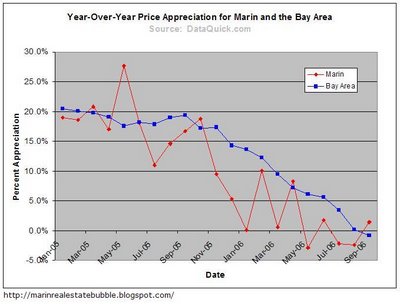
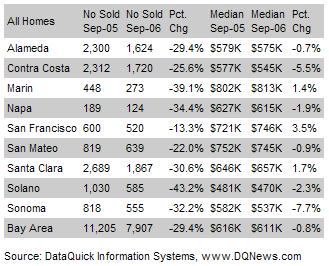
The following table and graph shows median price appreciation and percent change in sales for most property types combined (e.g., houses, condos, etc.) according to DataQuick:
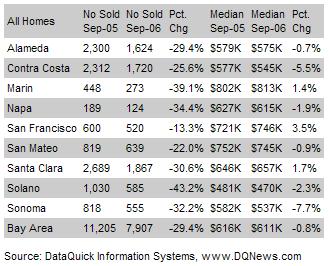
In addition to the eye-popping year-over-year -39% decline in percentage sales, according to the Marin IJ's DataQuick report Marin single-family houses depreciated -3.3% year-over-year in September:
The median price of existing single-family homes in Marin County fell 3.3 percent from September 2005 to September 2006...Marin's single-family home median was $869,000 last month, down from $899,000 in September 2005, according to DataQuick Information Systems, based in La Jolla.

Marin's decline was even more pronounced when compared with August, when the median single-family home price was $920,000. But DataQuick noted that an August-to-September drop is a seasonal commonality.

The overall number of homes sold in Marin declined 39 percent from September 2005, showing a persistently difficult market for sellers.

"We're going to see every county go a little bit negative within the next three or four months," said DataQuick analyst John Karevoll.
I also noticed that when talking about "market distress" this time around DataQuick has, for the first time since I've been reading these reports, changed their wording from
"Indicators of market distress are still largely absent"
to
"Indicators of market distress are still at a moderate level"
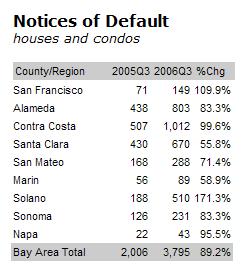
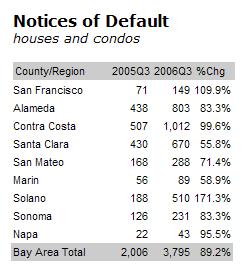
Hmmm... Well, they are reporting a steep increase in default activity with notices of default in Marin up nearly 59% year-over-year (not surprisingly, that's lower than most other Bay Area counties):
Here's what Vision RE sees:
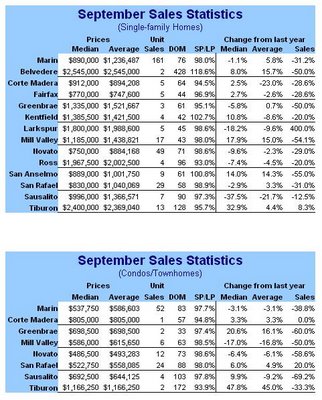
I think agent Liz McCarthy's comments in her newsletter for this month are spot on. Basically, only the nicest of the nice houses in the best locations in Marin are selling (and thus keeping price appreciation hovering around 0%); everything else is languishing. Once the sellers of the languishing houses get real, watch out below:
The best way to describe the current Marin Real Estate Marketing is “interesting.” 2 weeks ago I know of a great San Anselmo property that went into contract just 4 days after it was put on the market for well over asking. This was a great family house in a popular neighborhood. What does the future look like? I feel that homes that are priced correctly, in desirable neighborhoods, in move-in condition are still selling quickly. Homes that are priced for last year’s market (over-priced), that are not in optimum selling condition or that have major drawbacks are sitting on the market.
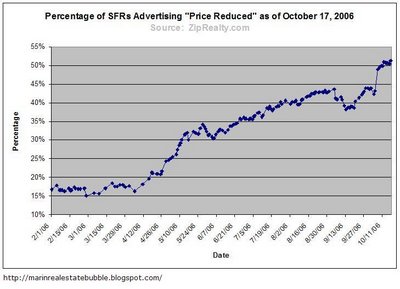
Below is that graph I show rather often showing the percentage of SFRs currently on the market that are advertising "price reduced" from their original asking price (source: ZipRealty). This graph is more about seller psychology as it references asking prices as opposed to actual sale prices.
Here's Thornberg's take on the latest housing data as quoted in the Chronicle:
Across the state, inventory more than doubled in the past year. Bay Area home prices fell last month for the first time in more than four years. ‘This is an enormous real estate bubble, bigger than we’ve ever seen,’ said economist Christopher Thornberg. ‘You’ve got to pay the piper.’
And from Reuters:
‘Buyers have finally taken off their rose-colored glasses. Once interest rates started to go up that made the housing market slow, which in turn made buyers wonder if this is the right time to buy,’ said Cynthia Kroll, senior regional economist at the University of California, Berkeley.
Take off the "rose-colored glasses" and "pay the piper" indeed.

See Ben Jones' excellent summary of the reporting on the September California results (and here).
Sunday, October 15, 2006

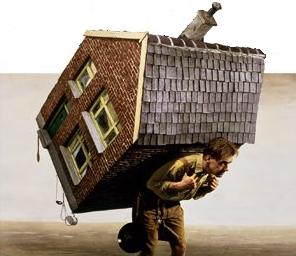
The Bubble

Source.

I'm starting a new job this week. It's going to be a lot of fun and a huge opportunity for me. And it should be fairly "recession resistant". Furthermore, I can start biking to work again. Yay!

Over this last couple of weeks I've been very busy doing some preparatory work. I expect to be "fed new info via a fire hose" at my new job for a month at least. So if you haven't already noticed, I am slowing down my contributions to this blog. I'll keep posting stuff as I see fit and keep certain graphs up-to-date. But really, what else is there to say?

Saturday, October 14, 2006

Were You Part of the Problem or the Solution?

So were you one of the people who let your greed, selfishness, and lack of foresight destroy housing affordability for so many people now and in the future? Was it worth it? Are you happy with yourself? How do you justify it to yourself, to your children? And what's the next get-rich-quick thing you'll be diving into?

Or were you one of the people who had the sense to stay out and not be part of the problem? How does it feel to be a martyr? How does it feel to have the affordability of something as important as housing be destroyed for you and your children?
ANNE TAYLOR FLEMING, NewsHour Essayist: It has finally happened. In the Sunday streets, here where I live in west Los Angeles, there has been a definite downshift. There are still plenty of open houses, still signs at the street corners beckoning drivers toward this or that destination.

But home sales dropped 25 percent in Southern California in August, the ninth straight month of falling sales. Nationally, new housing starts are down over 20 percent since their peak. In short, the air has definitely been let out of the housing bubble.

Now, we're a little shell-shocked as we look around at the crazy, manic time we have lived through and how it transformed the landscape. In my neighborhood, there was something wild about it, a kind of frantic, optimistic acquisitiveness, packs of people spending their Sundays roaming from house to house. Some, yes, just looking, but others intending to buy, a Tuscan villa, a mini-chateau, a fixer-upper, or a tear-down on a desirable lot where they could then build lot line to lot line.

Many of the small houses like mine have been scraped away to make way for giant replacements. There were many days I couldn't get down my street for all the trucks, the constant nerve-jangling noise of construction the daily soundtrack.

Of course, it wasn't just here in Southern California. Similar things went on in many other places: Vegas and Atlanta, Houston and Miami, and New York, too. People flipping houses, buying second ones, huge places with all the appurtenances, the granite countertops, and designer faucets, and flat-screen TVs.

A status issue

No question it was a status thing, people identifying themselves as one of the haves in an economically divided country. But there was something else, an attempt to stem some innate longing or loneliness or insecurity. "This is me. This is where I belong. Here I will be happy. Here I will be safe, from terrorists, and flu bugs, and gang-bangers."

Real estate brokers became the lead players in novels by some of our finest writers, Mona Simpson, and T.C. Boyle, and Richard Ford, all those fictional brokers ruminating about the American dream as they ushered perspective buyers through Midwestern tracts or gated L.A. communities or quaint East Coast towns.

Of course, plenty of people, the young, the poor, and even the middle class, were priced out of the frenzied real estate market going in. Even in parts of the country where prices never reached the stratosphere, hardworking people were not immune to refinancing their homes in order to buy all those relentlessly advertised goodies.

Now there does, at last, seem to be a respite from the frenzy. House prices are down, and so are those refis. People will be hurting, as usual, those who can least afford it, the construction and landscapers and those who work in plants that manufacture furniture, and appliances, and all the other symbols of the good life, not to mention those who signed on for one of those tricky mortgages.

And yet it is hard not to be happy about the cessation of this frenzy, certainly for anybody clinging to the old-fashioned notion of a neighborhood of small, friendly, affordable houses. Alas, in so many places -- certainly here where I've lived for 35 years -- that world is now permanently gone.

I'm Anne Taylor Fleming.
You can read the original transcript here or you can see the video here.