Monday, June 12, 2006

"The New World Order Angels of Death"

A reader sent me this article. Because I watched Underworld this weekend (horrible, unless, perhaps, you are a teenage male) I think I was well-primed to appreciate the analogy of the Fed as being made up of 'financial-lifeblood-sucking vampires'.

Some choice quotes:
Ben is damned if he does and damned if he doesn’t – raise interests that is. If he raises interest rates to quell any signs of inflation or to strengthen the dollar against foreign currencies, he risks putting the economy into a recession.

Rising interest rates will destroy the bond market, and with the bond market the real estate market will follow. Real estate has been the backbone of the economy. If it goes the economy will go with it.

If Ben lowers interest rates, he runs the risk of inflationary pressures getting too far out of hand, causing the dollar to weaken even further, which then may cause the recent foreign bank diversification out of dollars to pick of speed.

Real estate has been the ultimate victim of the vampires of structured finance. Every drop of liquidity has been bled from the host – no more remains. You cannot get blood from a stone; no matter how hard you try.

There is no longer a readily available supply of victims to feed all the creatures thus created – the vampires of the New World Order. Housing provided a large host for quite some time, a feeding bank if you will, but its days are numbered and falling by the wayside.

Whereto will the creatures turn – for the sustenance, they need to survive? They have already gorged on all possible victims – nothing remains alive with the needed lifeblood within. Structured finance has built an economy of paper houses built upon paper promises – promises that cannot and will not be kept.

It has provided a false degree of confidence and misplaced optimism in a speculative boom in the credit and debt markets that have inflated asset prices to absurd levels. As interest rates rise – debt becomes harder and harder to service. Suddenly assets must be liquidated at much lower prices then their recent high-water marks.

Sunday, June 11, 2006

The Summer of Seller Discontent?

Given the pathetic sales and pricing (and here) in May, 2006 here in "God's country", one has to wonder if this so-called "buyer's market" is really a buyer's market. I mean, clearly a lot of sellers in Marin are still thinking it is the summer of 2005 as far as pricing is concerned even though a third of them are reducing asking prices. So is it really a buyer's market? Why buy now if prices are coming down and will continue to do so? Surely more and more Marin sellers will get a clue and start pricing more realistically:
May and June are traditionally the best months for real-estate sales, but this May and June have been ‘very, very slow,’ says Dan Scher of Ledgewood, who has been selling real estate for 25 years.”

“It’s the worst market he has seen in 10 years, for himself and other agents. The root of the problem, in his view, is that sellers are stuck in a time warp and refuse to budge from their lofty asking prices.”

“His advice for buyers: It’s not a bad time to buy, considering the large number of houses for sale. But look for a seller who’s aware that this is the summer of 2006, not last year."
As DinOR says over at Patrick.net (I paraphrase): "If the offer you give to a seller doesn't embarrass you, then you are offering too much".

Saturday, June 10, 2006

"Look Out Below"

A reader sent this in. The author does a nice job of delineating the various phases of the real estate cycle. I agree that we are currently sitting on top of or just past the inflection point and all paths lead down as the data for Marin and elsewhere confirm. Here is his prediction going forward:
THE NEXT FEW YEARS
Phase V: - The Future: Look Out Below. The problem becomes obvious and virulent when real estate values begin to fall. With debt service costs rising, real estate begins to flounder, and more risky real estate ends up on the rocks. As default rates rise, mortgages slowly become more expensive and difficult to obtain (“real estate becomes a four letter word” in the parlance of an old banker). Only brave and knowledgeable entrepreneurs venture onto the scene of real estate wreckage at the lowest tide. Only a “foolhardy lender” would venture between the rocks of the now quiet ebb tide.

The “virtuous cycle” has completed its turn into the “vicious cycle.”

HOUSING AND CONSUMER SPENDING
It is our view that the “irrational exuberance” has transferred from stocks to housing, setting up conditions for a “housing deflation.” We expect a serious fall-off of home construction, sales and values, starting in 2006, and becoming very pronounced by 2007. A glut of new houses will accumulate in the next 12-24 months, causing a drop in price and construction of new units, and setting up a serious risk of price decline (similar to the “tech wreck” in the stock market).

More May Data for Marin

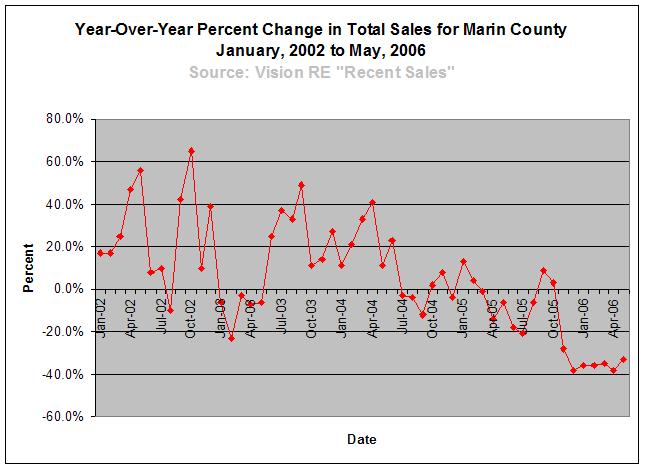
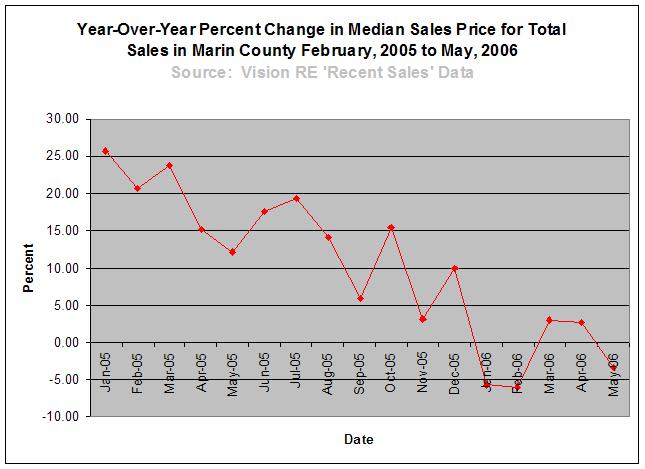
Here are some more charts updated for May, 2006. I am thinking of not doing these sorts of charts every month anymore and instead moving to every other month or so. Let me know what you think.


Keep in mind that May and June are traditionally the best months for sellers of residential real estate. If this May was as good as it gets these days, then the rest of the year should be interesting.

Friday, June 09, 2006

May, 2006 Results -- Vision RE

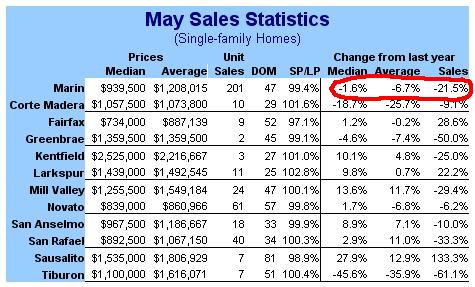
Here is the latest from Vision RE. I just love the way they try to spin May's results in the most positive way possible while still being honest.

Are those actually minus signs in front of some of those price "gains" in their chart? That can't be right because everyone knows that prices in Marin always go up (ok, to be fair, this is not the first time Marin house prices have gone negative). Who wants to bet that DataQuick's May report on appreciation in Marin will be down close to 0%?

Anyway, here's their low-down:
Year-over-year sales were off 21.5%.

The median price for homes fell 4.6% from April to $939,500, a year-over-year decline of 1.6%. The median price is now down 8.7% from the peak price of $1,029,250 reached in June 2005.

...on one hand we have prices dropping, on the other hand, homes are selling faster and for closer to their asking price. Another item to note is that inventory has almost doubled since January. It’s a strange market that is still in transition.
Roughly 32% of all listings are marked as "price reduced" according to ZipRealty. I'll show the chart of that as well as others in a later post.

"It’s a strange market that is still in transition". That's for sure. It's transitioning downward: percent sales way down, inventory nearly doubling, a third of sellers offering price reductions, negative year-over-year "appreciation". Does that sound like a strong Marin market? The effects of increasing interest rates are only just beginning to be felt.

The Fool's Take on the Squirming NAR

God bless the Motley Fool:
“There’s nothing funnier or more satisfying than watching the National Association of Realtors change its tune these days. The latest news release from this sunny-Jim industry group finally fesses up to its past fiction, but even when it admits the bubble’s going to pop, it can’t muster the courage to just come out and say it.”

“...the NAR is full of it and will spin the numbers any way it can to keep up the pleasant fiction that all is well....The cracks began to show in subsequent remarks from NAR ‘Chief Economist’ David Lereah. The head outfit that ridiculed the idea of a housing bubble for years is now crying for Ben Bernanke to bring it back. ‘But this is a time for the Fed to pause on rate hikes because we have some interest-sensitive housing markets that have become vulnerable,’ Lereah said.”

“The real problem here isn’t the NAR, of course. You have to expect these people to spin the facts for their industry. No, the real problem here is the uncritical press out there, which is all too happy to pepper every contrary indicator or bearish remark with an NAR official’s informed-sounding bubble denial. Never mind if what the NAR folks are saying doesnt seem to make sense (or contradicts what they said just a few months back).”

“It should have been completely obvious to anyone with a loan calculator and a glance at wage increases that those months of industry bubble denials were just wishful thinking.”

Thursday, June 08, 2006

Attempting a Soft Landing at High Speeds

As you have probably noticed, Blogger has been having some serious problems the last couple of days. I haven't been able to post and you haven't been able to leave comments or even view the blog at times. Sorry about that. It just goes to show that not all things Google are golden.

But wow! The last few days have been rather interesting. Unlike his predecessor, Ben Bernanke is proving himself to be one who speaks his mind when asked what he thinks. He's clearly worried about inflation and Wall Street has reacted with nothing but sell-offs this week; the DOW is down nearly 500 points and is now well below the 11,000 mark. I've heard it said that the housing equities markets are leading indicators for the housing market itself; if so, there is no so-called "soft landing" in sight as real estate building stocks have lost up to half of their value over the last two or three months. David Lereah, chief economist for the National Association of Realtors, is clearly worried (despite all of his cheerleading and spin) and knows full well how vulnerable the various bubble housing markets are to interest rate hikes and has essentially begged the Fed to stop raising rates. Yeah, sure, like the Fed is really going to stand for the complete transformation of our economy to one based on real estate. Sorry folks, but the strength of the dollar takes precedence and you real estate agents had better start looking for other work; go find the next get-rich-quick scheme and if worse comes to worse I hear WalMart and fast food joints are hiring and they don't require much in the way of qualifications either.

And don't forget that the Fed has previously warned us not to expect a bail-out.

This article sums things up pretty well:
Ouch. It's getting harder and harder for real estate agents to put a happy face on the market. Sales are slowing, prices are falling, and the backlog of unsold homes is rising fast. And now it's suddenly looking like the Federal Reserve will raise interest rates again.

Bernanke's gladiator-like aggressiveness on inflation is producing scowls at the National Association of Realtors, which worries that higher mortgage rates will make the housing market even softer. The group put out a public statement on the issue this week, in which David Lereah, the Realtors' chief economist, said: "This is a time for the Fed to pause on rate hikes because we have some interest-sensitive housing markets that have become vulnerable."

...it's clear that the Realtors' association isn't happy with the way things are unfolding. It predicts that existing-home sales will drop 6.8% this year, to 6.6 million, while new-home sales will tumble 13.4%, to 1.11 million.

"So Mr. Bernanke is 'monitoring,' all right," Rosenberg [Merrill Lynch's chief North American economist] wrote in a report on June 7. "He's monitoring the collapse of the housing market, and by the sounds of it he wants to reinforce the bear market already under way."

[Real estate stocks] have lost anywhere from one-third to more than a half of their stock market values. In a note to clients, A.G. Edwards & Sons wrote, "If it is not already painfully apparent, the soft-landing thesis for the homebuilding industry is dead."

...DeKaser points out that the market still hasn't fully adjusted to the rate hikes that have already occurred. In fact, he says, according to an analysis that he plans to release next week, some of the most overvalued markets are continuing to see some big increases in prices. That's setting them up for an even bigger fall to come, he says.

What goes up must come down. One housing bear, Ian Shepherdson, chief U.S. economist for High-Frequency Economics in Valhalla, N.Y., wrote June 6: "Ultimately, we expect the level of home sales to head down to, or even below, the long-term trend. When bubbles burst, they usually burst properly. Gentle deflations are rare."