Friday, July 07, 2006

The "Soft Landing" Myth

I still don't really know what is meant by a "soft landing" other than it sounds a lot better than a "hard landing" or a "crash landing". But if this is even a little accurate it seems that the odds of a "soft landing" (whatever it may be) are small:
The hope of investors that the economy will gently ease into a soft landing is based more on myth than reality. Although the vast majority of economists and strategists are forecasting a soft landing rather than a recession, the fact is that soft landings have rarely happened in the past 50 years, and the consensus of economists has never accurately forecast a single recession. In addition every recession has been preceded by a bear market.

Over the last 50 years the Fed has made three or more consecutive tightening moves 11 times including the current period. Of the prior 10 times, 8 have led to recessions and 9 to bear markets. The only true soft landing occurred following the tightening series of 1994, and, of course, this is the template that analysts like to use as a comparison to the current period. The only other instance where the economy did not fall into recession following a series of tightenings was in 1966, which was a close call. In that instance, however, the Dow plunged by 27%, hardly a soft landing for investors in the market.

Significantly, in 9 of the 10 tightening periods the spread between the long-term Treasury rate and the t-bill yield narrowed to under 50 basis points. Once again, the exception was 1994, the one instance that was not followed by a bear market or recession. Therefore, in all 9 instances where the Fed tightened and the yield spread dropped below 50 basis points, a bear market followed—and 8 times a recession occurred as well. In the current period the Fed has hiked rates 17 straight times and the rate spread between long treasuries and t-bills has dropped below 50 basis points.

It seems that before every recession economists and strategists ignore the strong evidence to the contrary and trot out the “soft landing” thesis as if this has been the norm. Hoping for a soft landing and pause in Fed rate hikes, investors are now cheering any indication of economic weakness. Judging by history, however, a soft landing appears to be merely the short window that occurs between the peak of an economic expansion and the subsequent recession. We see no reason why the outcome should be any different this time around. The current economic expansion is already one of the longer ones on record and is looking long in the tooth. If anything, other forward-looking indicators such as high energy prices, a weakening housing picture and global monetary tightening make an oncoming recession and bear market even more probable. While anything is possible in both the market and the economy, it seems to us that the odds against a soft landing are extremely steep.

Another Financial Dodo on the Path to Extinction?

It looks like we will soon be able to say goodbye to so-called "piggyback loans". Piggyback loans, like most of the other "exotic" loan types, were created, so it was claimed by the lending industry, to make housing more "affordable". Well, we all know these loan products only made houses less affordable over time and put many people at greater financial risk. Anyway, if these types of loans go the way of the Dodo then even fewer people will be able to "buy" their dream Marin POS at today's prices. To the extent that people used to save money for a down payment, these loan types are one of the reasons why the US savings rate is negative. Don't be a Dodo.
Wall Street is sounding the alarm on one of the most popular ways to buy a house in many high-cost areas around the country, so-called ‘piggyback’ programs.

As of July 1, the most influential ratings agency in the mortgage arena, Standard & Poor’s, has upped the ante for lenders who seek to fund piggyback deals through capital market financings. The move is likely to raise interest rates and fees for some homebuyers this summer, mortgage experts say, and could reduce the volume and availability of piggyback programs overall.

The reason for the change is that an exhaustive study of the performance of piggyback loans found them anywhere from 43 percent to 50 percent more likely to go into default than comparable stand-alone first-lien purchase transactions.

Piggyback plans were developed as a creative response to soaring home prices and borrowers’ desires to stretch their down-payment cash. According to a study, piggybacks quadrupled their market share between 2001 and 2004. In a sample of loans in California markets the percentage of piggybacks exceeded 60 percent in some cases.

If you were hoping to make a windfall on your house, then you have to 'sell now before it's too late'. If you are a buyer, then it behooves you to wait as the deals will only get better and better. That implies a deadlocked market which is pretty much what we have now in Marin. So maybe the market is rational after all.

"Sausalito By The Bay" Needs to Get Their Facts Straight

I just discovered this reference to my blog in the Sausalito By The Bay blog:

Are You an Emotionally Manipulated

Housing-Debt-Serf?” in this land of costly homes?

That’s the question asked in the funny video on YouTube, featured on the blog Marin Real Estate Bubble, run by some anonymous person yet reaping 4,763 “views” since it was started last July.

See some photos and wry commentary about “Marin’s insanely over-priced housing market at the companion blog, Marin POS.

To give you a sense of the tone of this blog, the current photo of a home has this caption, ” I Thought Versailles Was in France or Something?

While Marin home prices are on your mind, you might as well visit here
and see the graph on prices.

I would just like to take this opportunity to relieve Kare Anderson (author of the Sausalito By The Bay blog) of her technical ineptitude and say that the Marin Real Estate Bubble blog has well over 200,000 views and nearly 1,000 unique (non-repeat) visitors per day since being registered with SiteMeter (I registered a few months after starting this blog and so the true numbers are almost certainly larger). Not much I admit but for a small, insignificant county like ours and the fact that I make almost no attempt to promote this blog myself, it's not too bad (my hope was and still is that readers who value this blog will promote it for me; idealistic I know).

But I appreciate the mention all the same. Thanks, Kare.

Oh, and assuming that post of yours is representative of your writing ability let me also take this opportunity to say that for an "emmy-winning former NBC & WSJ reporter, publisher of Say it Better ezine, author of SmartPartnering & LikeABILITY & speaker" your writing skills leave much to be desired. For my part, I make some effort on this blog to write well (not perfectly mind you, just well) and use punctuation correctly as I believe that one's writing reflects on the individual and I don't want to inadvertently encourage the ever declining writing skills of our youth by writing poorly myself. You should take your pseudonym (i.e., "sayitbetterkare") as sound advice.

Thursday, July 06, 2006

Is Cheney Betting on a Collapsing Housing Bubble?

According to this, Dick Cheney is betting a very significant portion of his wealth on a weakening dollar and a plunging housing market along with all that they entail:
In theory, you can tell what a person expects from how he invests. The theory hasn't been applied to important public officials much before. Kiplinger's Personal Finance applied it to the Cheneys' financial disclosure statement and printed the analysis under the provocative headline, "Cheneys betting on bad news?"

The bad news would be of two kinds: A higher rate of inflation and a lower value for the dollar.

If you add up the money in just the accounts Kiplinger's considered, he [Cheney] has between $23 million and $65 million invested. From its analysis. Kiplinger's figured that the Cheneys' total assets could be as much as $94.5 million.

Kiplinger's got the inflation hint from the Cheneys' stakes in a fund that specializes in short-term municipal bonds, a tax-exempt money market fund and an inflation-protected securities fund. The first two hold up if interest rates rise with inflation. The third is protected against inflation. The disclosure statement provides ranges for the investments, so Kiplinger's could tell only that the Cheneys have between $10 million and $25 million in the municipal bonds, between $1 million and $5 million in the money market and between $2 million and $10 million in the inflation-protected securities.

The hint about a loss of value of the dollar comes from their $10 million to $25 million in a foreign, mainly European, bond fund.

There is a caveat here. The vice president turned his money over to outside managers. Kiplinger's quotes Mr. Cheney's lawyer saying the vice president has "nothing to do" with his money.

You have to wonder, though. It's customary for top officials to put their money where they don't have day-to-day control of it. For some jobs, that's the law. Still, who could keep his lips locked if he knew something his money manager could cash in on? The hands-off approach is a fig leaf that the public demands, but a strong breeze will blow the leaf away.
For a more reactionary interpretation of all this, click here.

Wednesday, July 05, 2006

She's Gonna Pop

The Northern New Jersey Real Estate Bubble blog has the goods on this Wall Street Journal article:
WSJ: How is the housing market?

Mr. Heebner [a manager of the CGM Realty Fund]: A significant decline in prices is coming. A huge buildup of inventories is taking place, and then we're going to see a major [retrenchment] in hot markets in California, Arizona, Florida and up the East Coast. These markets could fall 50% from their peaks.

WSJ: What has you so concerned?

Mr. Heebner: I'm worried that more people will default on their mortgages. Risky mortgages such as interest-only and pay-option adjustable-rate mortgages require no principal amortization and in some cases payment of only a fraction of the interest due, have been widely used in the last two years. Some people got 100% financing for their homes. It made the tech bubble look like a picnic. When housing is going up rapidly and you can buy far more than your income can support, some people are eager to make big profits by extending themselves financially.

As housing prices fall more people will be under water, and these people are just going to walk away from their homes. They are going to say, 'I'm outta here.' You're going to see increasing foreclosures over the next several years. As [home] prices come down, it will create a difficult environment for home builders.
Remember, approximately 70-80% of all recent home loans in the Bay Area were some form of ARM.

And if you "owners" out there are having trouble keeping up with your payments, and since many of you can no longer afford to have children anyway, you can always take this route:
Cortney Henderson is one of the faces of America's housing affordability crisis. She never could have qualified for a mortgage here — where the median home price is $607,000 — had she not had the $27,000 she made as an egg donor...

Henderson's story points up the extremes to which some Americans are now willing to go to buy a home in some of the most overheated markets.

Tuesday, July 04, 2006

Come to Marin, It's Not as Bad Here

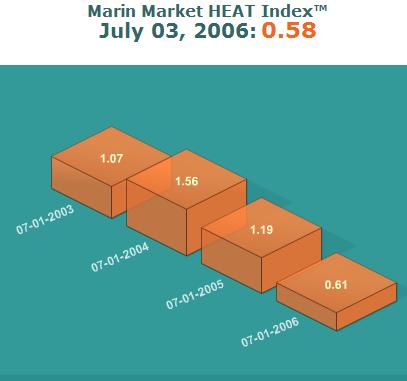
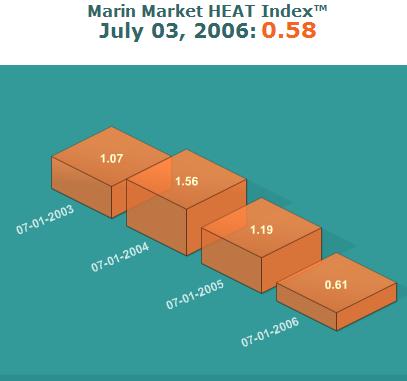
As you can see in the above graphic, the Marin Market Heat Index is at or near an all time low. Never before has Marin real estate been so out of favor, at least according to this index. Even the realtor who publishes this index says the "reading hit 0.58 on June 26, the lowest reading since the Index began in 2002".

And it's still at 0.58.

Unfortunately, instead of discussing the likely down-side consequences for the Marin real estate market, instead of warning potential buyers about the near-term (1 - 5 years) future market conditions, the best this realtor can do is say 'well, at least it is not as bad here'. Denial, pure and simple:
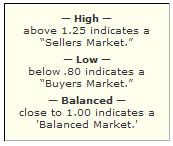
Heat in the real estate market is a somewhat relative concept. Everyone agrees that the real estate market in general has cooled significantly in recent months. That has certainly been true for Marin where the Market HEAT Index reading hit 0.58 on June 26, the lowest reading since the Index began in 2002. Remember, 0.80—1.25 means a balanced market, so 0.58 is squarely in a Buyers Market area.

But since market heat is relative, we can take a look at a county near here to see what the HEAT Index is there. Would it surprise you to learn that on June 30 the HEAT Index rating for Sonoma County was 0.40 and that the Napa County index was even lower? This is significantly lower than the rating for Marin. Even in times of slower, cooler markets, real estate activities in Marin maintain at higher, healthier levels.
  • Marin County--0.62 [should be 0.58]
  • Napa County--0.38
  • Sonoma County--0.40
  • Solano County--0.38
  • Mendocino County--0.32
Furthermore, this realtor is hedging his statements by stating "Remember, 0.80—1.25 means a balanced market..." So what? We are a long way from a "balanced market". The scale is as follows:

According to this Index, Marin is in a solid and unprecedented "buyer's market". But frankly, IMO it's not a "buyer's market" until the excesses wrought by this housing bubble have completely blown away.

It is not in the least bit surprising that areas that are further from the nearest major employment center (i.e., San Francisco) are suffering more than those closer to the major employment center. Furthermore, Napa, Sonoma, and Mendocino counties are popular vacation/second house locations. I've said it before on this blog, as have many others, that vacation houses are the first to go and that the collapse of the bubble will work its way inward -- towards the employment centers. So far, the pattern of results are confirming that prediction (but faster than I would have thought).

Sunday, July 02, 2006

The Price of Being Short-sighted

One of the things that amazes me the most about this housing bubble is that people who buy houses these days show no interest or concern for the absolute amount of debt they are taking on nor how long it will take to pay it off. Instead, we have become so short-sighted that all that matters is the monthly nut. Sure, I understand the pragmatism of focusing on the monthly mortgage payment, but surely one would think that overall debt accrual would enter into the buyer's thinking at some point.

Well, if it is only the monthly mortgage payment that effectively governs how much someone is willing to pay for a house, then it is easy to understand that as interest rates go lower, the amount of debt one can "afford" to take on increases. As one can take on a larger loan for the same monthly mortgage "cost", the overall price of houses increases while the monthly mortgage payment stays about the same.

It seems reasonable then to suppose that the reverse process is equally true in a rising interest rate environment: the monthly payment must remain approximately constant. Given that interest rates are rising and the monthly payment must remain the same, then the only factor that is left to freely adjust is the absolute price of a house which must come down in a rising interest rate environment as long as the monthly payment must stay about the same. Either that or incomes rise.

Well, as incomes are not rising at a particularly perky clip -- suck it up sellers and deal with it: