Thursday, February 01, 2007

Survey Says... You Suck

LOL! Thanks to a dedicated reader for this one.

Q: On what basis do most people rate a job as being prestigious?
A: The most prestigious jobs are those that most help other people.

Q: What job is rated by most people as second to least prestigious?
A: Real estate agent/broker (second only to stockbroker).


Well, look on the bright side. All you wannabe stock gurus/day traders back during the NASDQ bubble who jumped on to the real estate get-rich-quick bandwagon after the stock bubble bust did manage to improve your prestige by 1%. What's it going to be next? Give us a heads-up, will 'ya?

What Happens When Easy Credit Is Not So Easy?

I found this referenced over at Ben's blog:
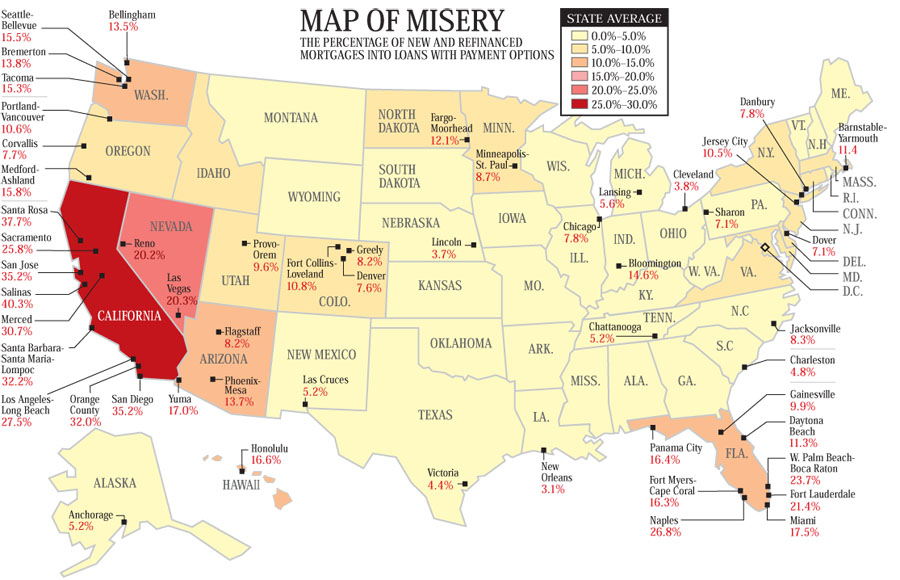
Those considering buying into the real estate 'soft landing' scenario ought to think twice. There will soon be over $1 trillion of adjustable mortgage payments increasing beyond the payment capacity of the borrower. Many borrowers, upon realizing that the monthly payment is about to adjust, will go searching for loan programs similar to their original loan.

New 'guidance,' handed down by the Office of Federal Housing Enterprise Oversight Committee, requires…the borrower must now qualify as if the adjustable loan had already changed to the highest rate possible under the loan program.

It has been estimated that 90% of all people who obtained these 'stated' income loans lied on their mortgage application about how much they made. On October 1, 2006, the IRS updated their capacity to respond to lenders' requests verifying borrowers' 'stated' income. In short, what used to take months to respond to will now take two days. Inside of 48 hours, the 'stated' income will be verified as false. How will these people qualify then?

According to RealtyTrac, lenders who foreclose on a property in Ohio get 57% of appraised value when they sell the property. That amounts to a 43% hit on principal!

Consider the inevitable: You have buyers in the market with a choice of inventory, which do you think they'll buy? A lender-owned property at a big discount or one owned by a private party for near full price?

In California, unsold inventory has grown by over 100% in one year. Thus far, there has been limited price damage because almost all of the properties for sale have been privately owned. In 2007, that will change. The new inventory for sale will consist of lender-owned properties, builder auctions, and short sales. All of these sellers will be selling to a less motivated, smaller group of less-able-to-qualify buyers.
I hear the piper and he wants to be paid. If Bay Area housing sale prices are to increase or even stay where they are either wages/salaries have to increase by a whole lot over a relatively short period of time or access to easy credit (a big part of which requires being able to state what ever you can get away with vis-à-vis income) must be maintained or made even easier. Many here in the Bay Area have had to make use of lying about their income on their stated income loans. Many others are dependent on other sorts of "toxic" loans. What happens when people cannot lie on their stated income loans? A whole lot fewer Bay Aryans can qualify for a loan, that's what. What happens when a whole lot fewer people can qualify for a loan? A whole lot fewer sales. The move-up chain begins to break down. What do sellers have to do to sell their houses? Lower the price down to where people can now get loans or wait for years and years for the selling environment to improve or bury a lot of St. Joseph statues or pray that an army of rich [insert your favorite foreign nationality] come in and swoop up properties. Good luck with that.

Oh, but wait. California is moving towards cracking down on the stated income loan. What will Bay Aryans do?
California lawmakers on Wednesday began considering restrictions on unorthodox mortgage-lending practices that have allowed hundreds of thousands of Californians to buy homes they otherwise could not afford.

'The exposure to these sorts of products, the growth, is unprecedented,' Raphael Bostic, an associate professor at the University of Southern California School of Policy, Planning and Development, told a Senate committee. 'The regulatory oversight of these types of practices is relatively lax.'

In September, five federal regulatory agencies issued guidelines calling on federally regulated lenders to better gauge borrowers' ability to pay before using the nontraditional loans. California is considering similar rules for state-regulated lenders, as have 24 other states, said Sen. Michael Machado.

About 60 percent of sub-prime loans in California those given to the highest-risk borrowers allowed them to pay only the interest or gave them that option on an adjustable rate mortgage, the Federal Deposit Insurance Corporation estimated. Many of those borrowers are at risk of losing their homes as the market continues to stagnate, witnesses said during Wednesday's hearing.

About 12.5 percent of riskier mortgages nationwide were delinquent by last fall. Nearly 1 million homeowners nationwide either lost their homes or missed monthly payments from July to September, according to the Mortgage Bankers Association.

'The market did not save them,' testified Pam Canada, executive director of Neighborhood Works Home Ownership Center in Sacramento. 'This was a nightmare with no happy ending.'

'We've already seen a dramatic increase in foreclosures here in California,' said Paul Leonard, California director of the Durham, N.C.-based consumer advocacy center.
And it will only get worse. More than $1 trillion of adjustable rate mortgages will reset in 2007 and given the Bay Area's dependence on "toxic" and "liar's" loans, I bet we will be one of the regions to be hit the hardest.

I've got my hard-hat. Do you have yours?

Sunday, January 28, 2007

How Will History Judge This Man?

...Alan Greenspan is either depraved or a fool and, of the two, I am not sure which I feel worse about as describing the man who was at the helm of the monetary bobsled during the longest stretch of paper credit expansion the world has ever seen.

Let’s play ‘connect the dots’:

1. In December 2002, private bankers warned Greenspan that consumers were taking on worrisome amounts of debt and that an unsustainable, interest rate driven housing bubble was fueling this behavior (page 22 of this linked document [PDF]).

2. In July of 2003 Greenspan lowered interest rates to one-percent (as in 0%, or one-point-oh), an emergency rate, and held it there for over a year (see chart below).

3. In February of 2004 Greenspan advised Americans that they’d be better off with adjustable rate mortgages (ARMs) than they would with fixed rate mortgages.

4. In October of 2005, the new bankruptcy law, largely written by private banking lobbyists and insiders, was passed.

Here’s how those data points look when plotted out on a chart of short-term interest rates:

To summarize; (1) Mr. Greenspan was warned that he was igniting an unsustainable asset bubble, (2) he threw more gasoline on the fire, (3) he then advised consumers to switch to ARMs right before what he knew (for certain) would be a protracted period of rising interest rates, and then (4) kept mum while bankers worked feverishly to pass bankruptcy legislation that was indisputably banking-friendly but a consumer nightmare.

Now here’s the interesting part about the story. To consumers, Adjustable Rate Mortgages (ARMs) are good or bad depending on whether interest rates are rising or falling. When interest rates fall the ARM adjusts down with them. The reverse is true when rates are rising...

But when we refer to the four data points in the chart above, we observe that Mr. Greenspan advised consumers to take advantage of ARMs right before the onset of what he knew would be a multi-year rate hiking campaign. Obviously he advised people to do the exact opposite of what they should have done.
Source.

Saturday, January 27, 2007

More on Habitat for Humanity Tiburon Project

There's been more written in the IJ about the Habitat for Humanity project in Tiburon that I blogged earlier. I found the following revealing quotes in the print edition of the IJ (Jan 25, 2007, pp. B1-2).

// Begin sarcasm //

The first quote that I want to pull from the article shows to the rest of the world how we wealthy, white Marinites now deal with our non-Caucasian residents here in Marin. You see, we like to keep them in specific areas where we can keep an eye on them and as far away from where we Caucasians want to live as possible (i.e., the nice areas). These areas are where we Marinites will allow property values to be weak and where it is ok to build affordable housing. And for you socio-psychologists out there, this is how we can pretend to be "doing our part" and ignore our guilt. It wasn't always so, but it is now.
But Patri [principal planner for the Marin County Community Development Agency] said it has been exceedingly difficult to find any place to squeeze in low-cost housing [in Marin] outside of the predominantly African American enclave of Marin City and the largely Latino neighborhood of San Rafael known as the Canal area.
// End sarcasm //

And then a couple of counter-points were made against some of the claims in the original argument made by the Tiburon residents fighting against the Habitat project:
"The argument that affordable housing lowers property values is a specious argument," Kilbridge [executive director of Habitat for Humanity's San Francisco chapter] said. "It doesn't hold water."
What a surprise. After all, by their own admission many of the residents who are fighting this project obtained their houses in the 50s and 60s and are making $50-60K annual income. In other words, they couldn't afford their own houses if they had to buy them today yet they have no objections being Tiburon residents themselves. If low income folks such as themselves are acceptable residents, then why do they think that other such folk would be bad for the community? Why do they think introducing new residents, who are financially like themselves, would automatically cause property values to fall, crime to increase, etc?

And then...
He [Kilbridge] said it is "a shame" that residents would raise $100,000 in an attempt to keep less fortunate families out of their neighborhood. "Do you know how many nails that could buy?" Kilbridge asked. "To us that's a lot of money that could be of such incredible use to the community."
Not to mention that $100,000 could be used to remedy the traffic and other problems in that neighborhood used by the Tiburon residents to fight against the Habitat project. Or is it that they don't really want to fix the problems; they would rather use them when needed to keep out other people? More of the "if we don't improve our infrastructure, people won't move to Marin" line of reasoning which has been thoroughly discredited by the test of time.

Finally:
"The idea that everybody is entitled to an affordable house wherever they want one is not valid," Duane [one of the Tiburon residents who is fighting against the Habitat project] said. "I would like to live in Cannes."
First off, no one has mentioned or implied a sense of entitlement. Entitlement is not the issue here but I can understand how one would want to make the issue about entitlement as that is an issue that is easier to fight. And secondly, yes, without doubt Duane could not afford a house in Cannes today. Yet nor could he afford his own Tiburon house if he had to buy it today. Another specious argument.

It seems to me that the arguments against this project are more about property values and Marin's systemic white-flight fear than anything else.

Well, don't despair. The following letter-to-the-editor in the IJ gives hope; as long as there are still people like this in Marin, all is not lost:
Neighbors cheer Habitat plans

This letter is in regard to Habitat for Humanity's proposed four small family homes in the Eagle Rock area near where we live. These homes might house people who educate our children, protect our neighborhoods and keep our local economy going.

Residents have voiced their opinion that four small homes are going to cause more traffic and safety issues than 6,000- to 7,000-square-foot houses would.

This NIMBY (not in my back yard) opinion is mistaken.

The probability of lower-income families having more than two cars each is unlikely, based upon Mill Valley demographics in the 2000 census. Building larger homes for higher-income families will likely bring in more than the average two cars, plus those of their landscapers, house cleaners, nannies, etc. This is what will generate more traffic. The $100,000 that neighbors hope to raise to fight Habitat for Humanity would be better utilized in improving the neighborhood by putting in sidewalks and stop signs.

Our family has lived here in the same [Mill Valley] house since it was completed in 1950. Our grown children are all productive members of their communities. Our income is about half of the $56,000 maximum required by Habitat for potential buyers. Does this mean we have to move out because we might lower the home values of the neighborhood?

Let's give three cheers for Habitat for Humanity and bring this area back to the family oriented area it once was.

Thursday, January 25, 2007

Notices of Default Up in Marin

The Mess That Greenspan Made blog has the scoop on the disturbing rise in foreclosure activity in California. Marin's notices of default have basically doubled. (I thought that couldn't happen in Marin. Weren't we supposed to be immune or some such? Something about wealthy folks and how financially savvy we are all supposed to be.)

The Marin IJ had this to say:
The number of mortgage default notices nearly doubled in Marin County in the fourth quarter of last year, mirroring an escalation in foreclosure activity throughout California, according to data released Wednesday.

Marin had 101 default notices during the quarter, up from 51 in the last quarter of 2005, according to DataQuick Information Systems, a La Jolla-based research firm.

The numbers continue an upward trend in the county, which had 89 default notices in the third quarter of last year, up from 56 in the previous third quarter of 2005...

Across the nine-county Bay Area, fourth-quarter default notices rose 134 percent between 2005 and 2006, from 2,292 to 5,362. Contra Costa County led the pack at 179 percent, followed by Napa County at 164 percent and Solano County at 163 percent.

"Several factors are at play here," said Marshall Prentice, president of DataQuick. "The numbers last year and the year before were very low because of strong sales and appreciation. Also, most defaults occur a year or two after the loan was made, so we're in a period where the loan pool is at risk."
Keep in mind that around 70-80% of all loans made in Marin and the Bay Area at large in 2006 were likely of the "exotic" type (and don't forget about the "85% are liars loans" post).

Ok, so notices of default have doubled in Marin and yet the massive number of crazy loans from 2006 haven't even begun to reset yet. How much worse is it going to get?

But no worries, right? I mean DataQuick is fond of saying:
"Indicators of market distress are still at a moderate level. Financing with adjustable-rate mortgages is flat. Foreclosure activity is rising but is still in the normal range."
Do you believe them?

Here's one reason why not to be so quick to believe DataQuick -- apparently, DataQuick includes foreclosures as sales when they calculate their stats for public consumption and they say they are not going to change what they admit is an error. Athena, over at the excellent Sonoma Housing Bubble blog, has the scoop.

And if that wasn't bad enough, nationally (so including markets that have not participated in the specu-frenzy), existing house sales this past year were the lowest that they have been in the last 24 years! And yet David Lereah says we’ve hit the bottom. I wonder if future historians will mark this point in time as the pinnacle of maximum denial.

Anyway, I guess it is high-time to resurrect this appropriately updated picture, first published on this blog:

SF Chronicle Chart of Marin Price Per Square Foot

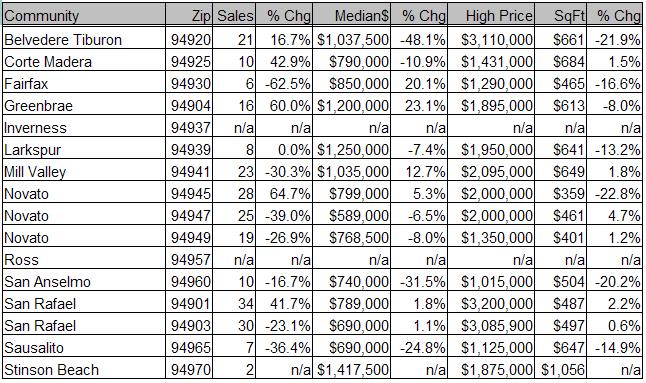
Here's a chart of Marin's December, 2006 results from the SF Chronicle care of DataQuick:

What I find interesting about the above chart is that they are showing the percent change in the price per square foot. Many rows where there is a positive percent change in the median sale price has a corresponding negative percent change in the price per square foot slot.

Is this indicative of how prices can drop while at the same time the median price in the county goes up a little or stays basically flat -- people are buying more house or a better house for the same amount of money?

Of Bubbles Past

It looks like that post I made back in September of 2005 has been making the rounds... the one chronicling news headlines from the last real estate bubble for comparison to the current one. Cool. Anyway, I thought I'd post it again since there may be new readers who would appreciate it.