Wednesday, December 07, 2005

Are RE Investors Running for the Exits?

Are real estate "investors" (you know, your local postman, barber, house-wife, janitor, sales clerk, etc. RE "geniuses") running for the proverbial exits? Given how RE is Marin's only real "industry" and is such a hobby here among the wannabes, the current trends are disturbing to say the least. Houses sitting on the market, crashing condo sales, reduced sales prices, vacancies, low rent vs. carrying costs, cash offers to buyers, even cars given to buyers (I've seen examples of this here in Marin ranging from Jaguars to VW Beetles). Sound familiar? Well, we'll see...

Some choice quotes:
"Individuals are pulling back from buying homes and condos as an investment, in a move that could accelerate the cooling of the housing market."

"...fewer people are competing to buy properties as an investment, real-estate brokers and housing analysts say. Some investor-owned properties are returning to the market for sale. With the pace of price appreciation slowing, some investors who were betting on quick profits are instead being squeezed."

"The apparent pullback by investors is recent and is just beginning to show up in national data."

"Sandra Geary, a broker in California's Sonoma County, was running seminars that drew as many as 200 would-be investors. She's also taken California investors on out-of-state home-buying expeditions to Arizona, Idaho, Nevada and Oregon and bought more than 30 rental properties for her own portfolio. But in recent months, her investor sales have fallen more than 75%."

"Some brokers are advising speculators to put away their checkbooks. "I'm telling people who want to buy new construction to flip it that the gig is up," says Frank Borges LLosa, a real-estate agent in Arlington, Va."
Some more choice quotes:
"Investors who helped fuel the U.S. housing boom by bidding up prices are now so desperate for buyers that some are offering cash bonuses..."

"Inventories of unsold single-family homes are near a 17-year high as demand from speculators wanes and mortgage rates have risen more than a percentage point from a four-decade low reached in 2003."

""We're at the turning point,'' says Susan Wachter, professor of real estate at the University of Pennsylvania in Philadelphia. ``We're all hoping for a flat market, and not a plummeting market.''"

"Declining demand from speculators will help slow home sales to an annualized 6.77 million this quarter from a record 7.24 million in the third quarter, says David Berson, chief economist at Fannie Mae. ``Perhaps investors have decided this is the right time to move out of housing and into other assets,'' he says."

""The mom-and-pop investors are unloading their properties,'' says Greg Sullivan, 42, a partner in Cash Now Vegas LLC, a Las Vegas company that buys homes from investors and resells them. ``When home values were going up $10,000 a month, everyone wanted in. Now, all those properties are sitting empty.''"

"Some experts say home prices in previously hot markets such as Boston and Washington will fall in 2006. Gramley foresees "declines in home prices of maybe 10, 15 or 20 percent on both coasts on a year-over-year basis.''"

Tuesday, December 06, 2005

Humboldt County Bubble

Humboldt County is a popular retirement destination for Marin County residents. According to the author of this PDF (a summary can be found here) Humboldt County is in a RE bubble:

Marin IJ Article About This Blog

Well, this blog got written up in the Marin IJ. You can read the article here. It's a dubious honor at best. At least the article was fairly balanced and my words were not grossly misrepresented. So kudos to the IJ.

The reporter who wrote the article had contacted me by email because someone had informed her about my blog. I guess that proves that word-of-mouth works in the blogosphere.

I'm not sure how I should feel about being accused of having "Marin real estate flu" by Jack McLaughlin, Marin's RE cheerleader and counterpart (it seems to me) to David Lereah. I'm not even sure how to interpret that comment but it probably was not meant kindly. Well, I haven't been too nice to realtors either so I deserved it. I will choose to interpret it as in jest. But now I understand why he never responds to my email (LOL!). It's too bad that Jack McLaughlin is missing the point of this blog but then it would not be in his best interest to positively acknowledge it either.

Well, time will tell...

Please let me know what you think (either post a comment or email me). Thanks.

Monday, December 05, 2005

OECD Study

Someone sent me a link to this PDF (OECD Economic Outlook No. 78 -- III. Recent House Price Developments: The Role of Fundamentals). It's dense but rewards with a lot of good information. Here are some highlights:

This graph shows "how strikingly out of step [real house prices are] with the business cycle":

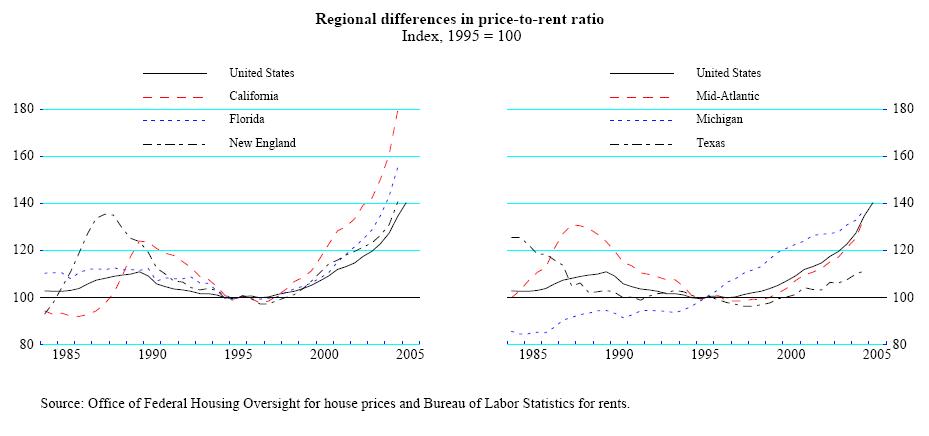
And this one showing price-to-rent ratios demonstrating how overheated the California housing market is relative to the nation as a whole as well as New England and Florida:

44.7% of Americans are in Denial

The results of this survey really make me laugh. Apparently, a whopping 67% of Americans believe there really is a real estate bubble ('yes Virginia, there really is a bubble') and 44.7% think that no one should talk about the real estate bubble for fear of causing panic selling. ROFLMAO! Sure, right, 'maybe if we don't talk about it, it will go away.' Never mind all those bulls who claim that panic selling can't happen in the real estate market because "real estate isn't like stocks", "people live in houses", "real estate only goes up", etc. This is nothing short of mass denial.

Then the survey results go on to say that the bubble will burst due to a "self-fulfilling prophesy". Well of course it will! Aren't ALL markets the result of a large number of human beings getting together to buy and sell things? And isn't all human buying and selling behavior the result of human psychology? So if someone realizes that housing prices are ridiculously high, he won't pay the price. And if a lot of someones come to the same realization, then the market as a whole is affected. Dismiss it as a self-fulfilling prophesy if it makes you feel better, but it all ends the same way. Then there is the fact that it is ok for there to be a self-fulfilling prophesy when prices are going up but when it works in reverse so as to re-establish a market balance then that is bad.

Some choice quotes:
"Over two-thirds (67%) of Americans believe there really is a real estate bubble, according to a recent survey by ThinkGlink.com, a leading real estate advice and information site."

"...a large percentage of respondents to the ThinkGlink.com survey (44.7%) indicated that people shouldn't talk about a real estate bubble because the more they talk about it, the more likely there will be panic selling that will lower property values. The respondents are concerned that simply discussing the real estate bubble might create a self-fulfilling prophecy."

"Of the survey respondents who believe there is a real estate bubble, just 18.1% believe the bubble will burst within six months. Accordingly, the other 81.9% of those respondents who believe a real estate bubble exists think the bubble won’t burst for at least six months. Another 41.3% indicated that the bubble won’t burst for at least a year and the balance (40.6%) predicted a real estate bubble would burst six to twelve months from now."

"Respondents voiced varied opinions on the topic of a real estate bubble. “The real estate bubble has got to burst. The housing prices in the suburbs are outrageous,” wrote a survey participant who lives outside of Washington DC."

Saturday, December 03, 2005

Rents vs. Mortgage

Over on another blog there has been a discussion going on about how dislocated are mortgages and equivalent rents (i.e., the disparity between how much the monthly mortgage is for a house vs. how much the same house can be rented each month). This reminds me of a question left on this blog (which went unanswered) a little while ago that went something like (and I paraphrase) -- "Everyone is always comparing the median income for an area with the median price of a house in that area; why should we expect the median income of an area to be able to afford the median priced house in that area?" To me and I think to many who read this blog the answer to that question is patently obvious.

Someone then posted this comment which I feel pretty much sums it up:
"The thing about renting is, you actually have to have the monthly income to qualify to make the payments. There is no neg am, no IO, no payment option, no drawing down home equity to get by every month. Rents reflect what people are actually able to afford based on their monthly INCOME, which is why the rent/buy ratio is so out of whack in many places.

Lenders and the GSE's (and other buyers of MBS) have been so helpful in making homes "more affordable". They have allowed prices to continue to skyrocket when the income was not there to support the prices. Their idea of affordability was allowing the buyer to borrow too much, but keep the payments "affordable" with crazy financing, all while allowing purchases with little to no down. Or, make homes "affordable" by simply doing away with income qualifications. Allow people to take on any amount of debt they chose without any verification that they have the means to pay it back, because of course their home equity will bail them out down the road.

This does not make homes "affordable", it puts borrowers in precarious financial positions in the name of making a buck.

Why are high home prices a GOOD THING??? We don't like it when the prices of life's other necessities goes up. But, higher home prices, WHOOPEEE..."
Here you will find the rent vs. mortgage data I published earlier for Marin County. My calculations were deliberately very conservative. Even so, mortages in Marin are more than twice the equivalent rent. The real figure is probably more like three times. And here you will find a graph of housing affordability for Marin County up through 2004 that I published on this blog a while back (which reminds me that I will be able to add 2005's data soon).

Check out this rent vs. buy calculator. Very interesting. I plugged in Marin's mean house price of about $1,000,000, its equivalent rent, assumed a yearly house appreciation rate of 5% (which is what realtors say we can expect now that the market is "flattening"), realistic values for a 30 year fixed loan (20% down payment [i.e., $200,000], etc.), and a 35% income tax bracket. The results came back as "Your home purchase does not breakeven after 30 years" and 'you should consider continuing to rent'.

Friday, December 02, 2005

Ultra-Cheap Credit will Soon be History (Again)

It seems that central banks around the world will act in concert to reduce the flood of excess liquidity that so many house buyers have become addicted to. If this happens, it is sure to destroy the RE bubble. Well, Greenspan did warn people when he said things like:
"This vast increase in the market value of asset claims [stocks, bonds, houses] is in part the indirect result of investors accepting lower compensation for risk. Such an increase in market value is too often viewed by market participants as structural and permanent... But what they perceive as newly abundant liquidity can readily disappear... history has not dealt kindly with the aftermath of protracted periods of low risk premiums."
Some choice quotes:
"Years of super-cheap credit are coming to an end as the world's major central banks begin to act in unison to drain excess cash that many fear could have severe repercussions for economic and price stability."

"As heads of the U.S. Federal Reserve, European Central Bank and Bank of Japan meet in London this weekend with finance ministers and bankers from the Group of Seven economic powers, they are likely to conclude there is still much to do."

"By the middle of next year, all three of these central banks may be withdrawing cash from the global economy -- via higher Fed and ECB interest rates or, in the case of Japan, by ceasing to pump even more cash into the system."