Sunday, April 30, 2006

Novato Blvd. Index

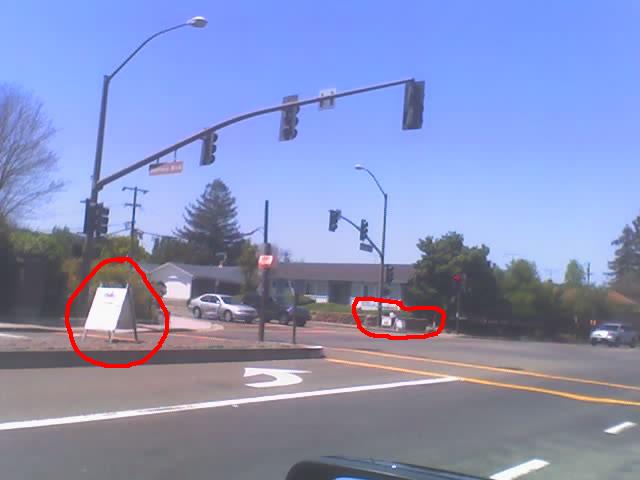
Driving up to Novato today (Sunday) to see a friend and get some sun I saw a ton of open house signs.

This one shows eight for sale signs:


This one from somewhere on Novato Blvd shows a cluster of seven signs:

The Novato Blvd. Index (NBI), where I drive the entire length of Novato Blvd., resulted in a total of 61 for sale signs.

Also, I counted nine for sale signs in the Inverness and Inverness Park area.

And yes, for those of you who have been wondering, "Dude, Where's the Car?" (aka "The Boat Garage") is still for sale as a house.

"In California, the Starter Home Market has Really Disappeared"

"In California, the starter home market has really disappeared".

That statement definitely rings true in the Bay Area. How sad is that? How long can that continue? It implies that the starter home market, which is the first rung of the 'move-up' ladder, is now totally dependent on debt for its existence.

Like this article says, the thing that has been saving people time and time again in recent years, and that has allowed them to take on such massive amounts of debt and feel like they don't have to worry about it, is the market itself. As soon as the market turns flat to negative people will learn the hard lesson of debt. And now that the bankruptcy laws have been tightened that will be a very hard lesson indeed. What happens to the Bay Area housing market as a whole when the 'starter home market' totally disappears because either no one in that market can get a loan or they're too afraid of debt?

This whole thing is so out of control it isn't even funny.

Some choice quotes:
"In California, the starter home market has really disappeared," said Tamara Draut, author of "Strapped: Why America's 20- and 30-Somethings Can't Get Ahead."

Younger adults are struggling to make ends meet, Draut said, because many have student loans and start with low wages, which make it hard for them to save and build wealth.

"Definitely, this generation has resigned itself to live in debt to live in a middle-class lifestyle," she said. Many consumers are comfortable with debt, but too much debt leaves people vulnerable, living paycheck to paycheck.

Some homeowners take advantage of rising property values to take on more debt and use the influx of cash to pay other debts, such as credit cards.

"The market keeps bailing people out of trouble," Lawson said. "Because people don't really get in too bad of position, they never really learn the lesson, and a year later they turn around and get themselves in the exact same spot."

"The concern is how do we keep our middle class with the housing costs going so high?" Gruen said. "Will people move from California if they have the option? Yes they will."

"The only thing that's keeping me here is my family," he [Peabody] said.

Peabody would consider moving to another part of the country where living is more affordable if he could land an appealing job.

Other people are wedded to living here regardless of the price.
A significant market decline is the only healthy way IMO to restore normalcy and long term prosperity. Anything less than that is likely to be an artificial and ultimately ineffective intervention that will only make matters worse. Let's hope the 'man behind the curtain' can see that. And yes, for the record, I will be hurt just as much as anyone else but it's still the truth as far as I'm concerned.

Friday, April 28, 2006

It's Official


I've noticed some new, repeating visitors to this blog and who are worthy of mention:
  • Executive Office of Asset Forfeiture, US Treasury Dept.
  • Social Security Administration
  • Internal Revenue Service
  • Bureau of the Census
  • Information Resources Management Administration
  • Admin OFC US Courts
  • Information Systems, U.S. House of Representative
Welcome. Such esteemed visitors are strongly encouraged to post comments.

Oh, and the Ameritech Electronic Commerce visitors, you can post too.

Losers Not Welcome in San Francisco

In San Francisco you are considered "low income" if you earn less than $95,000 per year:
In San Francisco, the income limits for resale homes (for one or two people) is $135,720 for moderate units, and $81,432 for low income units, and for new construction (read: South Beach High Rises) $135,720 is the moderate limit and $95,004 is the low income limit.

How crazy is that? You're low income in San Francisco if you make less than $95,000 per year. Looks like the lines for affordable unit lotteries are going to grow exponentially now...
Thank you Mr. Housing Bubble!

Source.

Welcome to NIMBY Northern California! Now go home before it's too late.

Liquefaction in Marin

The Bay Area recently "celebrated" (although "commemorated" might be a better term) the centennial of the infamous 1906 earthquake that devastated San Francisco and rocked the fledgling Marin County. REskeptic sent me a lot of great info about fault lines and such in Marin (did you know there is a fault line that runs right through Mill Valley?). Hopefully, he will post an in-depth article (hint, hint) about earthquake risk in Marin as it turns out that he is quite knowledgeable in that subject.

However, I found a nice USGS site showing the risk of liquefaction in various areas of the Bay Area. I pieced together bits of the map specific to Marin and show it below (click on it to enlarge it). If you must buy into the Marin POS lifestyle then at the very least you can use this map to assess your risk of losing it all to liquefaction as well as to help you decide whether paying for earthquake insurance is a good idea.

Thursday, April 27, 2006

Useless Marin Factoid of the Day

So I was wondering how many realtors there are per person in Marin County.

I asked these people if they would tell me for free how many realtors there are in Marin and they kindly did so; there are 1,677 realtors in Marin as of today.

According to the U.S. Census Bureau data, in 2005 Marin's total population was about 246,960 people. The U.S. Census Bureau says that in the year 2000 20.3% of the county's total population was 18 years of age or younger. So assuming that percentage was the same in 2005 as it was in 2000, that puts Marin's total adult population in 2005 at roughly 196,827 bodies (and one arm in change).

That means in 2005 there was about one realtor per 117 adults in Marin.

If we assume that all of those adults are "coupled" to a Marin adult resident (e.g., married, living with, whatever -- basically, buying a house as a couple), then there is one realtor for every 59 adult couples in Marin.

What does it mean? Nothing. It is a useless factoid.

Update: The Marin Assessor's office says that a total of 4,304 SFR sales occurred in Marin in 2005. So that would be one realtor per 2.6 SFR sales. Again, meaningless.

Wednesday, April 26, 2006

Marin Heat Index

The "Marin Heat Index" is currently lower than where we've seen it in a very long time. My thanks go out to a reader for the "heads up".


Here is that realtor's write-up of what it means to him (minus the speculative stuff):

Recently, Marin real estate experts have been saying that our local market is again becoming a Sellers Market. This is not true.

In recent days new sellers have entered the market in large numbers, while buyer activity levels have dropped. The Marin real estate market has made a very sudden and very sharp course adjustment. The Marin Market HEAT Index (MMHI)has declined by 21% in just eight days. It now stands at 0.76. This MMHI level indicates a Buyers not a Balanced, and certainly not a Sellers Market.

In eight days:

  • The MMHI has declined from 0.96 to 0.76;
  • The number of available homes for sale rose by 14%;
  • The number of homes in contract to be sold declined by 9%; and
  • The number of closed sales declined by 2%.

Simply put, this means the number of sellers is increasing, while buyer purchases are declining.

It's nice to see a Marin realtor actually call it the way it is.

And then there is this gem (referring to the report (warning - PDF) that indicates an increase in new-home sales):
Let me get this straight: Mortgage and interest rates are on the rise. Household finances are also being pinched by record gasoline prices. Yet somehow, Americans have all of a sudden decided to go out and buy a whole slew of new homes?...

[Why? It's because of price reductions.]

...What does this mean? While demand for new homes may be up, this is clearly turning into a buyer's market.

So if you're in the market to purchase a new home, wait. If you show some patience, chances are home sellers will be putting their properties in the discount bin.