Thursday, March 30, 2006

Wealthiest Counties -- Marin Need Not Apply

Marin didn't even rank among the wealthiest counties according to this survey. What is Marin's hubris founded on if not its imagined sense of self-worth? That's gotta hurt. ;)

Some choice quotes:
A survey released today by TNS Financial Services ranked Los Angeles County, Calif., the wealthiest county in the United States, based on the number of millionaire households.

TNS' annual survey of wealthy U.S. households is based on a representative national sample of more than 1,800 households with a net worth of $500,000 or more, excluding primary residence.

According to the survey, Los Angeles County has 262,800 millionaire households, which constitutes 23 percent of the state's wealthiest households, the survey found. Cook County, Ill, came in second with 167,873 millionaire households, followed by Orange County, Calif. (113,299 households); Maricopa County, Ariz. (106,210 households); San Diego County, Calif. (100,030 households); Harris County, Texas (96,593 households); Nassau County, N.Y. (78,816 households); Santa Clara County, Calif. (75,371 households); Palm Beach County, Fla. (69,871 households); and Middlesex County, Mass. (67,552 households).

I Know You Are but What Am I?

Sheesh! The Chinese have a better understanding about why the prices of our houses have gone through the roof than Boobus Americanus does. The United States has positioned itself between Scylla and Charybdis: what's more important, a strong dollar or keeping people's house prices artificially inflated? Naturally, our spineless politicians and the Fed are looking for a third way out -- saying it's all China's fault and that they should change. Good luck with that. China is just doing what's in their best interest and there is no reason why they shouldn't.

Hey America, it's pretty simple: if you mess up you room, clean it up yourself; if you live in a glass house, don't throw stones.

Update: Apparently, Asians are preparing for a dollar collapse. We already have good reason to believe that the Fed won't protect house prices and instead will come to the dollar's rescue.

Anyway, there is a great discussion (as always) about this over at The Mess Greenspan Made blog.

Some choice quotes:
The solution is with the United States and not, as pointed out by Governor Ben Bernanke in March 2005, with global savers. The problem is not the global savings glut, it is the lack of savings in the United States on the part of the government no doubt, but also on the part of the individual households.

Believe it or not, the extremely low household savings in the United States can be partly attributed to the rising housing price. Think about it: Who needs to save if his house is gaining value astronomically? By the time of retirement, all he needs to do is to cash in on the house or get an annuity through reverse mortgage to pay for all the bills for the rest of his life (increase in rental cost consistently falls short of the increases in housing price).

Saving little is indeed rational if the housing price continues to rise at its current pace indefinitely, if down payment and mortgage cost remains low, and if the dollar does not collapse in the foreign exchange market. Unfortunately, these are big "ifs."

We need the Fed doves to help remove the lid on the long rates and break the wishful thinking that cheap financing is always around for property purchase, for fiscal budget deficit, and for current account deficit. The property market will cool off. With well-targeted CPI inflation rate eating into the value of the house and with dollar depreciating against all major currencies, the property market bubble will shrink over time.

The US households will finally begin to realize that they need to save for their retirement nest egg, or else, be prepared to face the reality that the equity they build into and the capital gains on their house won't be enough to keep them happy for the rest of their retirement life.


Wednesday, March 29, 2006

Today's News

I've been enjoying some of the thoughtful discussion you all have left in some of the previous posts. I hope that can continue.

I've been pretty busy at work and so I didn't have time to post much. But here is a list of the housing bubble related news. It's all rather negative; no sweeteners today, just more vinegar. The article discussing how talent is leaving the Bay Area because of the declining quality of life (to a great extent caused by the outrageous cost of decent housing) is good but not terribly surprising to those of us who have been watching and discussing this bubble for a while now.

U.S. mortgage rates rose Tuesday

Ben Stein: Housing will continue to decline

New chief keeps raising rates, hints at more to come

Foreclosure shock !!

Mortgage defaults to rise as housing market slows

US home loan demand falls to lowest level this year

Prices, sales slip for new houses

Delinquencies peak the third and fourth years of mortgages

Lennar says earnings up 34% before housing market Killed

US home foreclosures on the rise

Jim Cramer: Real estate now like Dotcoms in 2000!

Homeowners face rising insurance rates

HomeRoute Names Top 100 Relocation Destinations

Insurers Backing Off Homeowner Coverage

Fed raises rates in Bernanke's first meeting

Sales stopped at off-Strip Las Vegas condo project

Nervous home sellers tossing buyers incentives

Bay Area's economic growth stunted by housing, education issues

The Apologists Club

Big Cali Quake on the Way?

A cold February for housing

THE FUTURE COURSE OF THE HOUSING BUBBLE

Bonuses to Loan Brokers Scrutinized

Home sales slowdown a boon to buyers: YOY price declines

EB take it to another plane

Mortgage Fraud Blog

There is a mortgage fraud blog worth checking out.

Tuesday, March 28, 2006

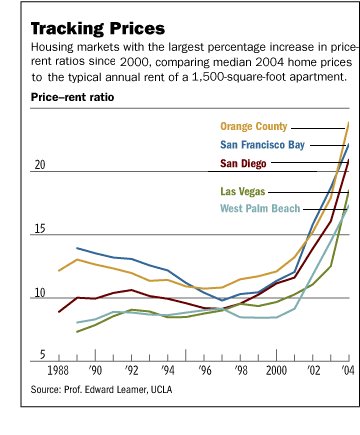
Price-to-Rent Ratios

A good series of posts on the housing bubble here and abroad can be found at this blog. Here is an interesting chart that I found there:

New Rules

This Wall Street Journal article describes some of the "new rules of real estate" now that the markets are trending down. I think Marin buyers and sellers could benefit by learning the rules of the new reality as of now, the inflection point of this housing bubble:
  1. Price your house in the bottom 25% of comparable properties.
  2. If you are looking to enter the market for the first time, don't overly stretch your finances because rising house prices will no longer bail you out; first-time buyers need to leave a financial cushion instead of stretching as much as possible and counting on rising house prices.
  3. New employees who are relocating to the area should steer clear of older construction where competition from newer construction could make reselling difficult.
  4. Say goodbye to the days when you could simply look at what your neighbor’s house sold for and then list yours for 10% more.
  5. Sellers need to make sure their house comes across as a good value relative to other houses on the market.
  6. Cut your asking price by 3% to 5% if your listing doesn't generate several showings or written offers within three weeks. Repeat until sold.
  7. Sellers need to help with closing costs.
  8. For employers: enforce policies that require transferees to price their houses close to the appraised value. Enforce ‘loss on sale’ programs, which compensate people who are relocating for losses when they sell below the purchase price.
I would add:

9. Only use agents who are willing to reduce their commissions down to 1% or 2%.

Monday, March 27, 2006

The Commission

Why do we have a system where both the buyer's real estate agent and the seller's agent are incentivized to encourage the highest sale price possible on a house? Shouldn't the buyer's agent be incentivized to achieve the lowest possible price whereas the seller's agent is incentivized to achieve the highest possible price? Is the only viable solution to remove all commissions from all steps of the housing valuation process (loan officers, appraisers, real estate agents, etc.)? Shouldn't the commission be replaced by a flat fee that has absolutely nothing to do with the sale/asking price of a house and everything to do with the actual amount of work the agent does? If there were a flat fee at all points in the process of buying a house, wouldn't that allow for more competition among the various players (loan officers, appraisers, real estate agents, etc.) and thereby result in fairer pricing of houses in our free market economy? What can be done to change the way agents, etc., get paid? Should something be done?