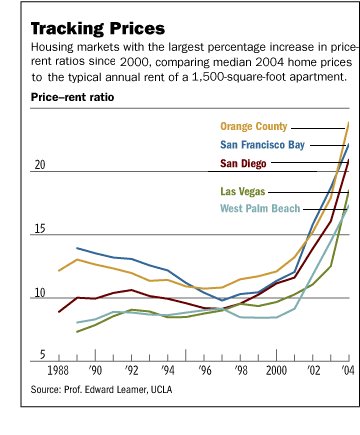
was a very bad idea (in hindsight) for all the right reasons. It is a significant factor that contributes to the very high cost of housing in California. Proposition 13 lessens the willingness to sell thereby decreasing the housing supply and, when combined with California's strict environmentally-based zoning restrictions, which further limit housing supply, is it any wonder that we find ourselves in the current mess?
Proposition 13 has greatly benefited homeowners whose homes have appreciated in value since it was passed, particularly those (such as the elderly) whose incomes have not risen as fast as property values. In cities with many older residents, this has led to a severe shortage of affordable housing, since new developments must often be far above the state's median home price in order to provide enough tax revenue to pay for the services they require. Impact fees have offset this problem somewhat, but are limited by developers' ability to go "jurisdiction shopping" for localities with low impact fees.
Owners of commercial real estate have also benefited: if a corporation owning commercial property (such as a shopping mall) is sold or merged, but the property stays deeded to the corporation, ownership of the property can effectively change hands without triggering Proposition 13's provision that fixes the amount of tax based on the property's resale value. Since many properties are nominally owned by shell companies whose sole assets are the properties in question, this has led to situations that have struck many commentators, such as Steve Lopez and Michael Hiltzik of the Los Angeles Times, as absurd and unfair. For example, the Times has reported that the property tax bill of the historic Capitol Records building in Hollywood is approximately five cents per square foot, while a small house assessed at $300,000 may pay up to 60 times that on a per-square-foot basis. Critics of Proposition 13 have argued that this situation unfairly benefits commercial property owners and should be changed, but recent attempted ballot initiatives have not succeeded in altering assessment formulas.
Proposition 13 has hurt mainly immigrants and young upwardly mobile workers in California. Because Proposition 13 is a disincentive to sell, there is less turnover among owners near the older downtown areas, and prices have appreciated fastest in these areas. Young people who would be wealthy in other states are house-poor in California, and are forced to live tens of miles from their workplace in order to afford a home. Thus, the Proposition can be seen as a "transfer tax" from the working classes to the retired class, as retirees are subsidized and the young have less working hours in their day because of long commutes. Immigrants are another class of losers under proposition 13, since they come from other states where property taxes are higher and their real estate equity buys less in the California housing market.
Imaginative strategies have been necessary for localities to compensate for Proposition 13 and the state's loss of most property tax revenue (which formerly went to cities and counties). Most California localities have recently sought their voters' approval for "special assessments" that would levy new taxes earmarked for services that used to be paid for entirely or partially from property taxes: road and sewer maintenance, school funding, street lighting, police and firefighting units, and penitentiary facilities. Sales tax rates have skyrocketed from 5% (the typical pre-Prop 13 level) to 8% and beyond.

California localities have taken measures such as using eminent domain and "redevelopment" laws to condemn "blighted" residential and industrial properties and convert them into sales tax generators such as shopping malls, multi-dealer "auto malls," and strip malls anchored by "big-box" retailers such as Costco and Wal-Mart. Cities that have been notably successful with this strategy include Cerritos, Culver City, Emeryville, and Union City. However, the spread of big box retail is credited as another major factor behind California's severe housing shortage, as cities have routinely rezoned vacant parcels and "blighted" neighborhoods for retail in an attempt to increase their share of the sales tax pie. With developable land made scarce by open space preservation laws and by the resistance of single-family homeowners to up-zoning, the resulting market pressures have led to urban sprawl that has brought formerly rural areas like the Antelope and northern San Joaquin Valleys into the urban areas of Los Angeles and San Francisco, respectively.
Some commentators have said that cities no longer control their own property tax revenue, and even claim Proposition 13 has exacerbated city-suburb class and racial tensions in California, particularly in Los Angeles. On talk radio and in other venues, working- and middle-class white and Asian residents of the conservative San Gabriel Valley often complain that the city of Los Angeles "steals" their tax dollars and funnels them into impoverished black and Latino districts.
Should Proposition 13 be repealed? If so, what should replace it? There are other states in this Union that do not assess property tax; how do they do it and still provide for public services? Post your thoughts. Write to your representative.
Personally, I favor a flat tax on all residents that has nothing to do with the value of a resident's property combined with tax exemptions for the folks that Prop 13 was designed to protect. But that's just me.